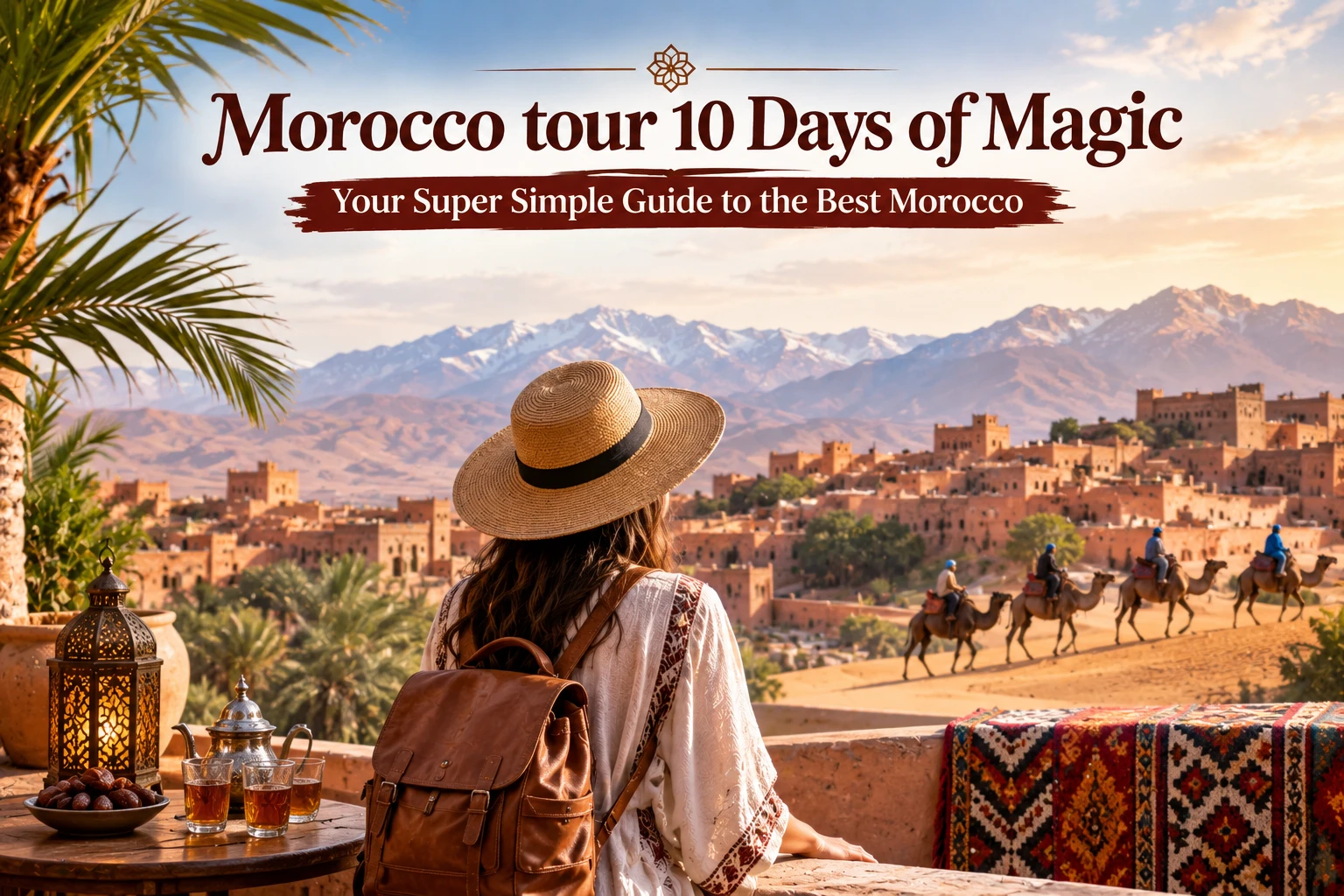
7 Essential cities in Morocco every traveler should visit in 2026

Morocco fits four former imperial capitals, a fortress city designed by a French military engineer for a Moroccan sultan, a mountain town painted the color of the sky, and the country’s main Atlantic port into a single trip. The challenge isn’t finding things to see, it’s working out which of Morocco’s essential cities earn a place on a short itinerary and which work better as a day trip from somewhere else. This guide covers seven: Marrakech, Fez, Rabat, Casablanca, Chefchaouen, Essaouira, and Ouarzazate, the gateway to the Sahara. Each section below covers what actually sets the city apart and what’s worth doing once you’re there.
Marrakech: The Red City
Marrakech is one of Morocco’s four historic imperial capitals, founded around 1070 by the Almoravid dynasty (a few early chroniclers date it a little earlier, to 1062). Its defensive walls, built in the early 1120s from local red clay, gave the city the nickname it still carries: the Red City.
Djemaa el-Fna, the square at the entrance to the medina, is the reason most itineraries put Marrakech first. UNESCO recognized it in 2001 as a masterpiece of the oral and intangible heritage of humanity, a designation later formalized on its Representative List in 2008, largely for what happens there after dark: food stalls, musicians, and storytellers who have worked the square for generations. By day it’s calmer, a market square framed by the Koutoubia Mosque’s minaret.
A short walk north, the Ben Youssef Madrasa shows a different side of the city. The original college was built in the 14th century under the Marinid dynasty, then almost entirely rebuilt between 1564 and 1565 by the Saadian sultan Abdallah al-Ghalib. At its peak it housed close to 900 students across 130 dormitory cells, making it the largest Islamic college in the Maghreb, and its carved cedar, zellige tilework, and reflecting courtyard pool remain some of the finest examples of Saadian craftsmanship in the country.
Rahba Kedima, the spice square tucked into the surrounding souks, rewards a slower pass. Stalls sell saffron, ras el hanout, henna, and dried botanicals used in traditional medicine, arranged in cones and baskets much the way they’ve been displayed for decades.
Fez: The Spiritual Capital
Fez was founded between 789 and 808 AD under the Idrisid dynasty and served as Morocco’s political capital at several points before the seat of government moved to Rabat in 1912. It never lost its other title: Moroccans still refer to it as the country’s cultural and spiritual capital.
Fez el Bali, the old medina, was the first site in Morocco to receive UNESCO World Heritage status, in 1981. It’s also commonly cited as the largest car-free urban area in the world, a walled district of narrow alleys where deliveries still move by handcart and mule rather than van.
At its center sits the University of al-Qarawiyyin, founded in 859 CE by Fatima al-Fihri. UNESCO and Guinness World Records both recognize it as the oldest continuously operating degree-granting institution in the world, predating Europe’s oldest universities by more than two centuries.
The Chouara Tannery, one of three in the medina, still processes hides using methods that haven’t changed much since the medieval period: stone vats filled with lime, pigeon droppings, and natural dyes such as saffron, poppy, and indigo. Terraces overlooking the vats let visitors watch the work without stepping into the yard itself.
Rabat: Morocco’s Modern Capital
Rabat became Morocco’s administrative capital in 1912 under the French Protectorate and has kept that role since independence in 1956, yet it draws far fewer visitors than Marrakech or Fez. That’s arguably its appeal: wide boulevards, an Atlantic waterfront, and historic sites without the crowds.
The Hassan Tower is the clearest evidence of Rabat’s earlier ambitions. Almohad sultan Yacoub al-Mansour began construction in 1184, planning what would have been one of the largest mosques in the world. Work stopped after his death in 1199, leaving the sandstone minaret unfinished at roughly half its intended height, alongside rows of stone columns that never supported a roof.
The Kasbah of the Udayas, a 12th-century Almohad fortress on the bluff where the Bou Regreg River meets the Atlantic, is the older, more residential counterpart. Its whitewashed and blue-painted lanes wind down toward a small garden and a viewpoint over the river mouth.
UNESCO added Rabat to its World Heritage List in 2012 under the title “Rabat, Modern Capital and Historic City: A Shared Heritage,” recognizing how the French-era new town, planned by architect Henri Prost, was built around rather than over the older Almohad city.
Casablanca: The Economic Capital
Casablanca was never one of Morocco’s historic imperial capitals, but it’s the country’s largest city and its economic center, and for most international visitors it’s also the first stop, since Mohammed V International Airport is Morocco’s main air gateway.
The Hassan II Mosque alone is worth a stop, even on a short layover. Designed by French architect Michel Pinseau and built between 1986 and 1993, it holds up to 105,000 worshippers: 25,000 inside the prayer hall and another 80,000 across the outdoor esplanade. Its minaret rises 210 meters, the second-tallest in the world, and part of the mosque extends directly over the Atlantic. It’s also one of the only mosques in Morocco open to non-Muslim visitors, on guided tours.
Beyond the mosque, Casablanca reads as a working city rather than a postcard one: an Art Deco-influenced downtown from the French Protectorate era, a modest medina, and a corniche lined with cafes facing the ocean. It’s a useful counterweight to the older imperial cities, a look at how Morocco actually runs day to day.
Chefchaouen: The Blue City
Chefchaouen was founded in 1471 by Moulay Ali ibn Rashid as a fortress against Portuguese incursions along Morocco’s northern coast. After 1492, it became a refuge for Muslims and Jews expelled from Spain, a history that still shapes the town’s Andalusian architecture.
Nobody can point to a single confirmed origin for the blue paint that now covers most of the old medina. The most cited explanation ties it to the Sephardic Jewish community, for whom blue represents the sky and the divine. Others point to a belief that the color repels mosquitoes, or that it simply reflects heat better than white walls. Historians generally agree the blue only became widespread across the whole medina during the 20th century, not the 15th, and that tourism helped spread it further from the 1970s onward.
Whatever its origin, the effect is real: walls, doors, and stairways in overlapping shades of blue, set against the green backdrop of the Rif Mountains. It’s most often visited as a day trip from Fez or Tangier, though the way the light shifts through the afternoon makes a longer stay worth considering.
Essaouira: The Windswept Port
Essaouira has been a coastal trading post since antiquity, known to Phoenician and later Portuguese traders as Mogador. Its current form dates to the 1760s, when Sultan Sidi Mohammed Ben Abdallah commissioned French military architect Théodore Cornut to design a new fortified port.
Cornut, trained in the Vauban school of French military engineering, laid the medina out on a grid, an unusual choice among Moroccan cities, which mostly grew organically over centuries. The result is a walled town that reads more like a Breton or Atlantic French port than a typical medina, complete with sea-facing ramparts still lined with 18th-century cannons. UNESCO listed the medina as a World Heritage Site largely for this blend of European military planning and North African craftsmanship.
The Atlantic wind that made Essaouira a difficult harbor for centuries is now its main draw for a different crowd: windsurfers and kitesurfers who treat it as one of the more reliable wind spots on the African coast. The working port, where blue fishing boats unload each morning, still supplies the grills lining the harbor with the day’s catch.
Ouarzazate and Ait Benhaddou
Ouarzazate sits on the southern side of the High Atlas, reached from Marrakech by crossing the Tizi n’Tichka Pass, and marks the point where Morocco’s imperial cities give way to the pre-Sahara. Its film studios, among the largest in the world, have earned it the nickname “Ouallywood,” standing in for settings from ancient Rome to fictional deserts on other planets.
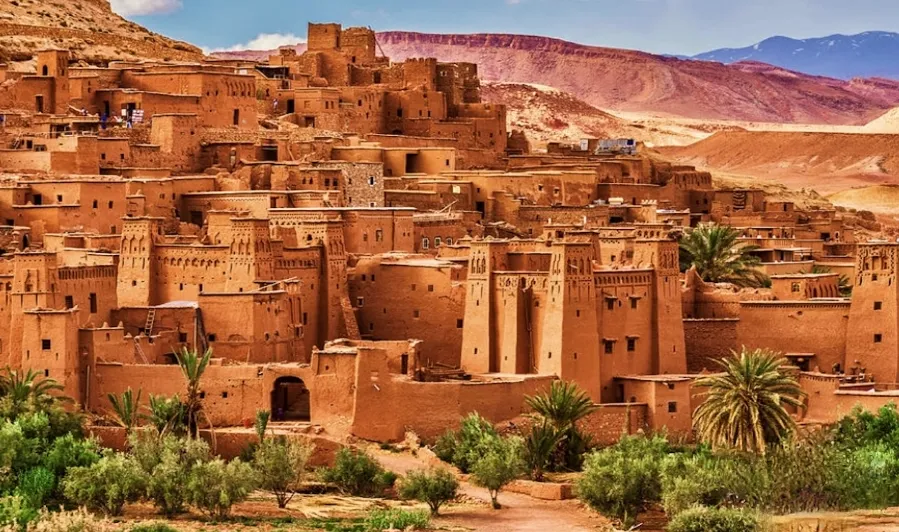
The main reason to stop is Ait Benhaddou, a fortified ksar on UNESCO’s World Heritage List since 1987. The site has been fortified since the Almoravid period in the 11th century, though the earthen buildings visible today, built from rammed earth and clay brick, mostly date from the 17th century onward. It sat on the historic caravan route linking the Sahara to Marrakech by way of the Draa Valley.
Its cinematic profile isn’t incidental: productions including Lawrence of Arabia and Gladiator filmed here, drawn to the same red-ochre walls that made it a defensible trading post centuries earlier. Most visitors treat it as a stop between Marrakech and the dunes further southeast at Merzouga, rather than a destination on its own.
Morocco’s Seven Cities at a Glance
A side-by-side view of how the seven cities differ, useful for deciding which ones fit a given trip.
| City | Region | Known For | Founded / Rebuilt | Best Reached By |
|---|---|---|---|---|
| Marrakech | Marrakech-Safi | Imperial history, souks, Djemaa el-Fna | c. 1070 | Train or international flight |
| Fez | Fès-Meknès | Oldest medina, spiritual capital | 789-808 AD | Train |
| Rabat | Rabat-Salé-Kénitra | Political capital, Almohad monuments | Capital since 1912 | Train |
| Casablanca | Casablanca-Settat | Economic capital, Hassan II Mosque | Rebuilt late 18th century | International flight |
| Chefchaouen | Tanger-Tétouan-Al Hoceïma | Blue-washed medina, Rif Mountains | 1471 | Road transfer, no rail line |
| Essaouira | Marrakech-Safi | Atlantic port, wind sports | Rebuilt 1760s | Road transfer, no rail line |
| Ouarzazate | Drâa-Tafilalet | Film studios, gateway to the Sahara | Ait Benhaddou fortified 11th c. | Road transfer via Tizi n’Tichka |
Planning a Trip Around These Cities
Morocco’s national rail network, ONCF, connects Casablanca, Rabat, Fez, and Marrakech directly and comfortably. Chefchaouen, Essaouira, and Ouarzazate sit off the rail line, so reaching them means a private transfer, bus, or shared grand taxi.
Covering all seven cities without rushing generally takes 10 to 14 days. A shorter week-long trip can realistically fit three or four: commonly Marrakech, one imperial city (Fez or Rabat), and either Essaouira or the desert route through Ouarzazate.
Spring, from March to May, and autumn, from September to November, offer the most comfortable weather nationwide. Summer turns extreme in Marrakech, Fez, and the pre-Sahara towns, while winter brings cold nights in the Atlas Mountains and rain to the north.
A common route runs Casablanca and Rabat first, two to three days, then Fez for two days, across the High Atlas to Ouarzazate and Ait Benhaddou for a day, on to Marrakech for two to three days, with Essaouira added as a day trip or overnight before departure.
Which Cities Are Worth It
Marrakech, Fez, and Rabat cover the imperial history. Casablanca shows the country’s economic present. Chefchaouen and Essaouira add mountain color and coastal wind. Ouarzazate opens the route into the Sahara. Which combination fits a given trip depends mostly on how much time there is and how far south travelers are willing to go, but almost any itinerary built around three or four of these seven cities will cover most of what makes Morocco worth visiting.