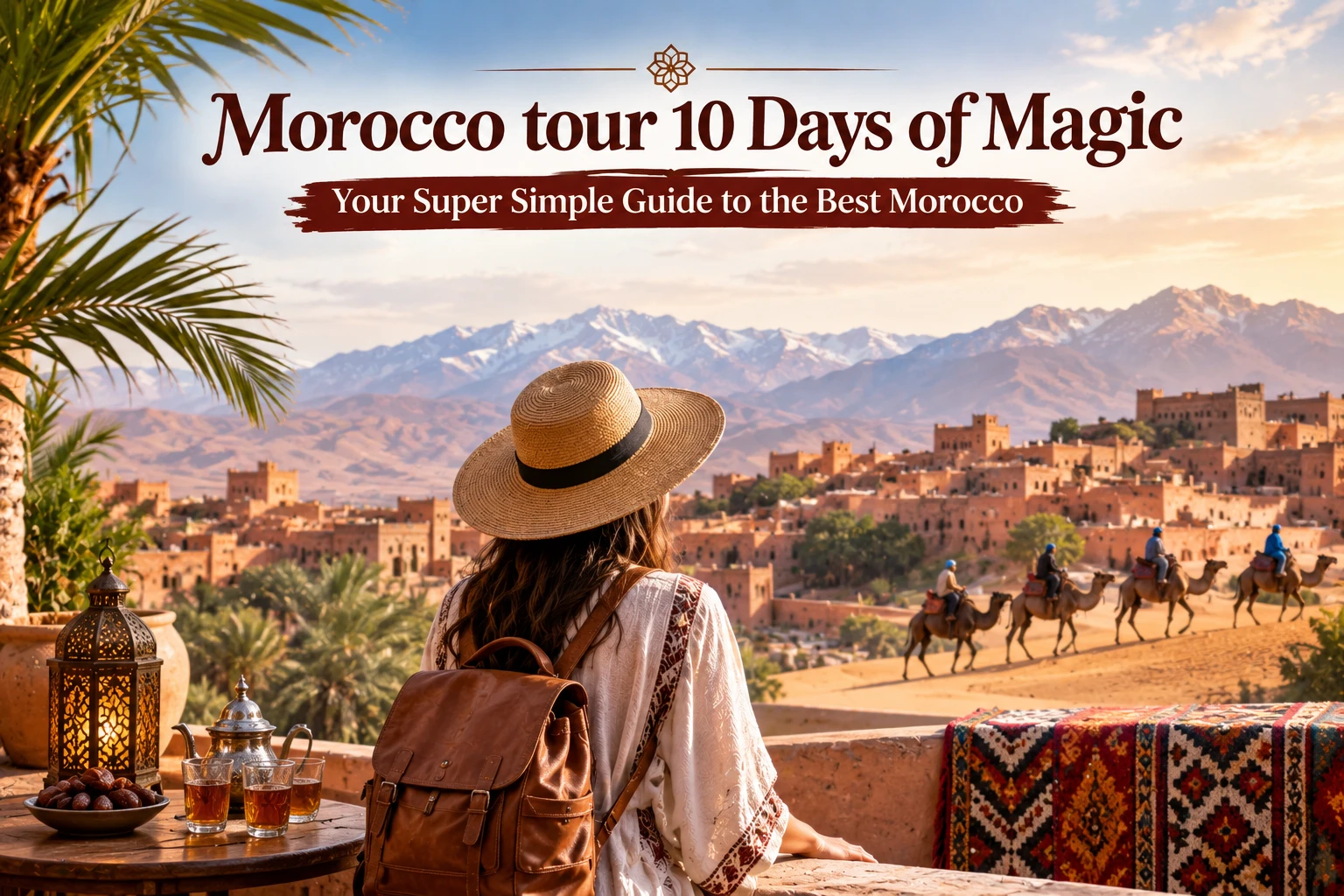

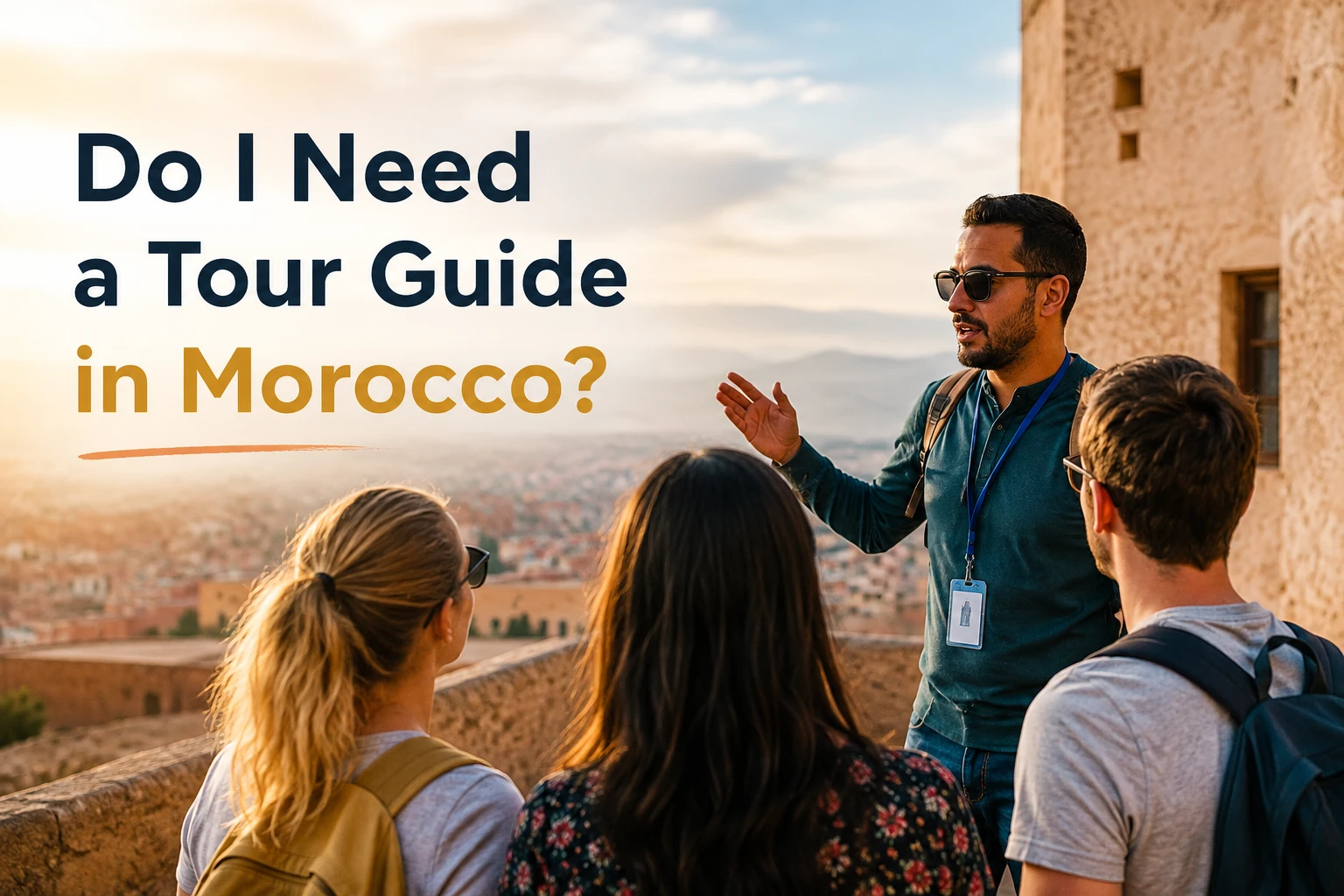
Somewhere between landing in Marrakech and standing in front of a hundred identical-looking alleyways in the medina, most travelers ask themselves the same question: do I need a tour guide in Morocco? The honest answer has less to do with your travel style and more to do with where in the country you are headed, because Morocco behaves less like one destination and more like several stitched together, imperial cities, mountain passes, Sahara dunes, and Atlantic towns, each one rewarding a different approach.
Quick answer
You do not need a guide everywhere in Morocco. In the old medinas of Marrakech and Fes, in the Sahara, and on Atlas Mountains routes, a licensed local guide genuinely changes the trip for the better. Coastal towns like Essaouira or Agadir, and a straightforward train ride between the main cities, are comfortable to handle on your own.
Do I Need a Tour Guide in Morocco? The Full Picture
There is not a single correct answer, because Morocco does not behave like one destination. If your trip is built around a handful of well-marked stops, a few nights in a riad, a walk through the main square, a day trip booked through your hotel, you can absolutely get by without a private guide. The moment your itinerary touches a historic medina, a desert circuit, or a mountain route, the balance shifts fast.
Marrakech and Fes were both built before cars existed, and their medinas were never meant to be legible to outsiders. Alleys fork without warning, shop signs repeat, and GPS pins often land you on the wrong side of a wall. A local guide who grew up navigating these streets does more than point you toward a landmark. They read the medina the way a sailor reads a current, and they know which doorway leads to a genuine artisan workshop instead of a tourist-priced imitation.
Officially licensed guides in Morocco are trained and certified by the Ministry of Tourism, and they carry a badge to prove it. That distinction matters more than it sounds, because unlicensed men offering to “help you find your riad” near busy squares are a well-known nuisance, not a shortcut. Working with a licensed private tour guide in Morocco removes that entire category of hassle from your trip, which is really the point of hiring a guide in Morocco in the first place.
Is Morocco Easy to Travel Without a Guide?
Morocco’s intercity network is more organized than many first-time visitors expect. The national rail operator connects Casablanca, Rabat, Kenitra, Fes, and Marrakech on comfortable, punctual trains, and Supratours or CTM buses reach smaller towns reliably enough that self-guided travel across the country is not the gamble it once was. French is widely understood in cities, road signage is bilingual, and booking a train ticket or a seat on an intercity bus takes minutes on your phone.
Independent travel in Morocco starts to ask more of you once you leave that main corridor. Ride-hailing apps work well in Casablanca and Rabat but barely exist elsewhere, so smaller towns still run on negotiated petit taxi fares. Solo travelers who plan a loose Morocco itinerary around trains and buses, booking a private driver or guide only for the trickier legs, tend to get the best of both approaches: freedom where the country makes it easy, expert help where it does not.
Where a Local Guide Makes the Real Difference
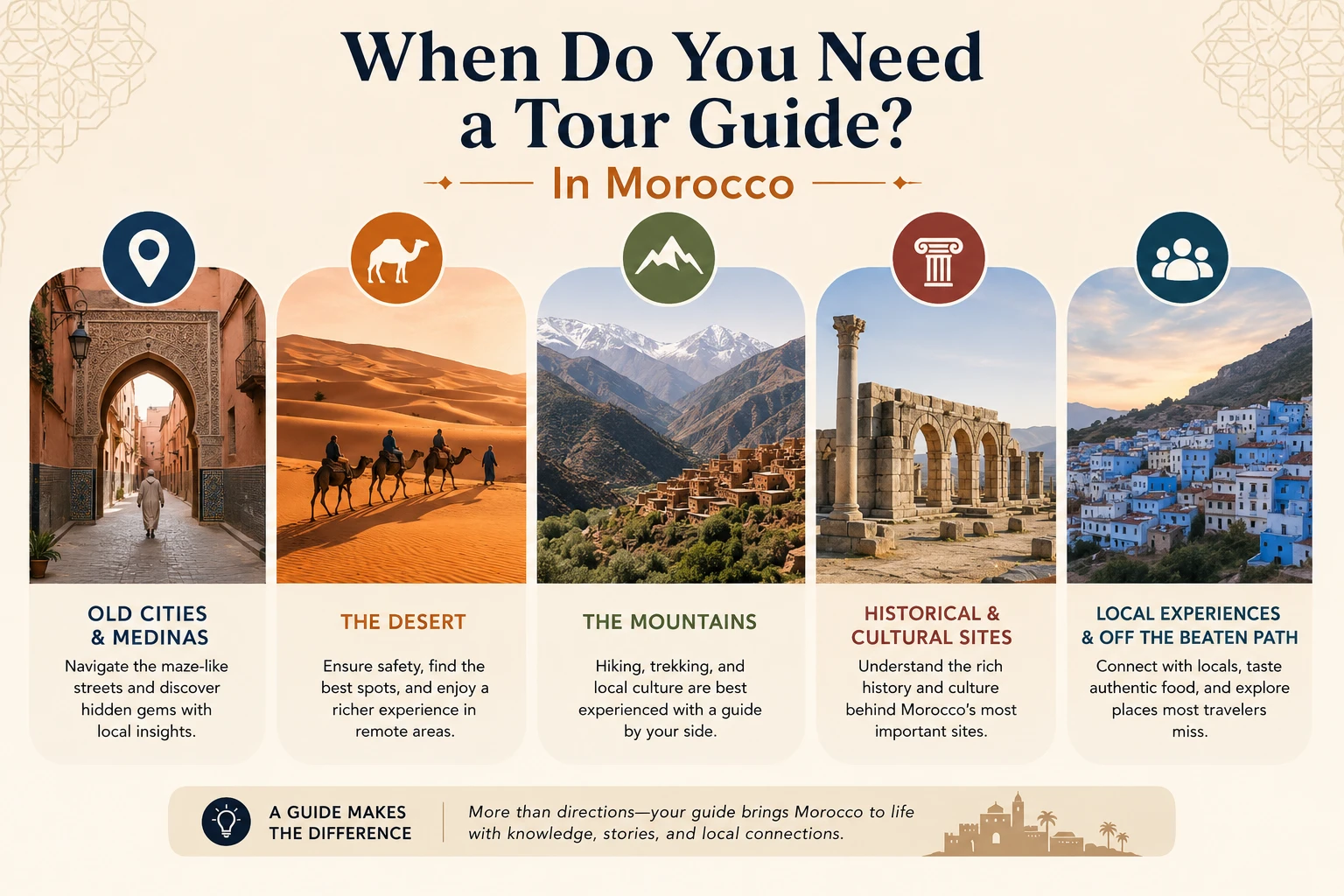
Three parts of the country change the calculation entirely: the old medinas, the Sahara, and the high mountain routes. Here is what that actually looks like on the ground.
Do You Need a Guide in the Marrakech Medina?
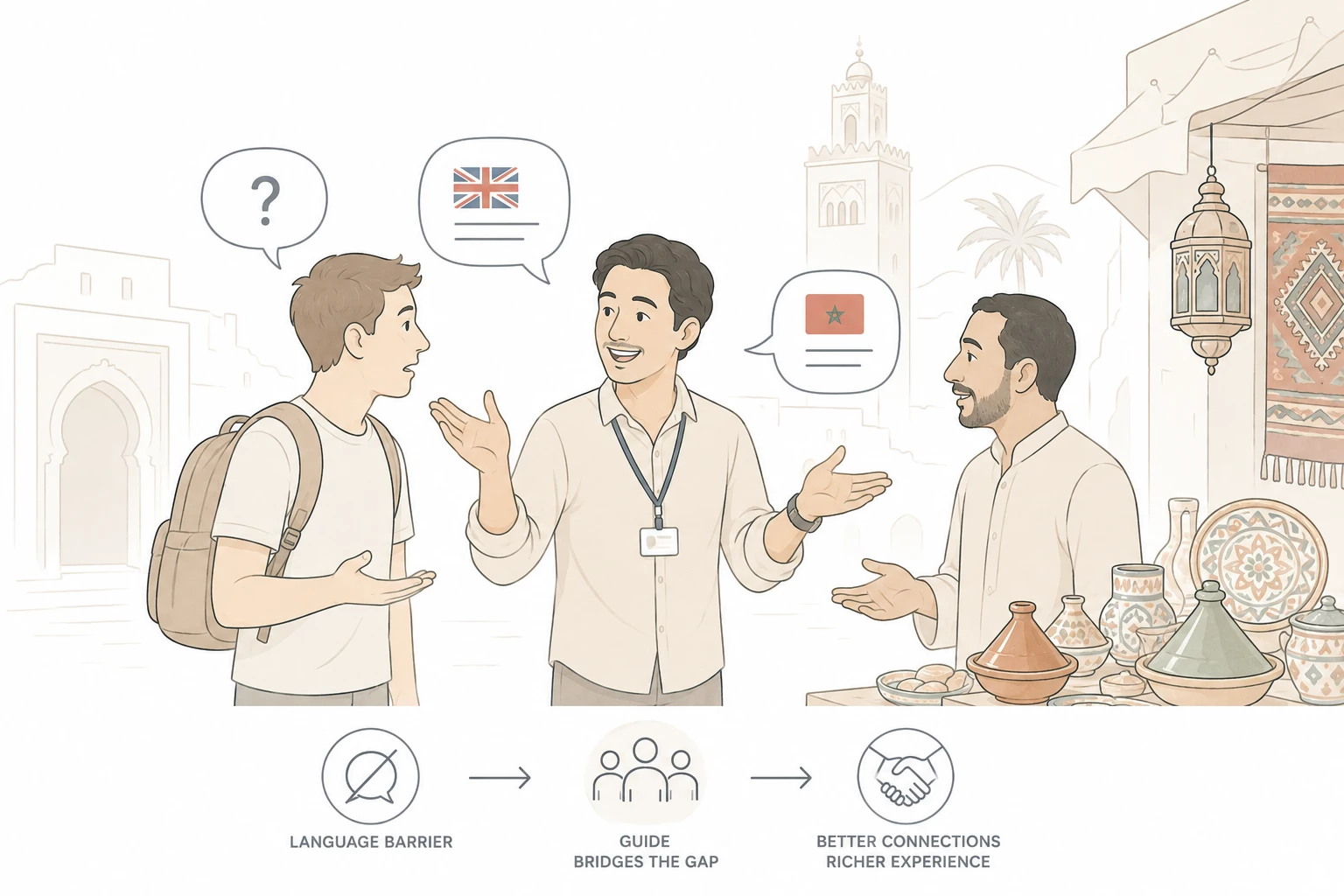
Marrakech’s medina spirals out from Jemaa el-Fnaa in a genuinely disorienting pattern, dyers in one pocket, tanners in another, spice and leather sellers layered through narrow covered lanes that start to look the same by midday. A Marrakech tour guide is not just there to point out the Koutoubia minaret. They carry a mental map most visitors never build in a week, and they know which workshops sell what they claim to sell. If your plan already includes a few days around Marrakech, a guide for even one morning tends to pay for itself in time saved alone.
Do You Need a Guide for Fes Medina?
Fes el Bali is older, larger, and steeper than Marrakech’s medina, and it is the one part of Morocco where nearly every visitor, independent-minded or not, ends up hiring a local guide sooner or later. No cars are allowed inside its walls, donkeys still carry goods through lanes barely a shoulder wide, and the layout has grown organically for over a thousand years rather than being planned. A Fes local guide will time your visit to the Chouara tanneries around the light and the smell, route you away from dead ends, and explain what you are actually looking at in the tanning pits, the medersas, and the ceramic workshops. Trying to see Fes properly without one is possible, but most travelers leave wishing they had booked the guide from day one.
The Sahara Desert and the Atlas Mountains
The Sahara and the High Atlas operate by different rules again. Reaching the dunes near Merzouga involves long drives, stretches of unmarked piste, and camp logistics that a Sahara desert guide handles daily and a first-time visitor generally does not. In the Atlas Mountains, weather turns quickly at altitude, trail markings are inconsistent, and a local Atlas Mountains guide knows which routes are safe on a given day, not just which ones look good on a map. These are the two regions where independent travel genuinely carries more risk, not just more effort.
Chefchaouen and the Smaller Towns
Chefchaouen is a different story again. Its blue-washed lanes are compact and genuinely walkable on your own, and getting lost here feels more like a feature than a problem. A short Chefchaouen walking tour still adds real value if you want the history behind the blue paint or the best light for photographs, but it is the one medina town on this list where independent travel is a comfortable, low-risk default rather than a compromise.
Guided vs Independent Travel in Morocco: Weighing It Up
Guided tours in Morocco and independent trips both have committed fans, and the right choice usually depends on where your itinerary takes you rather than which camp you belong to.
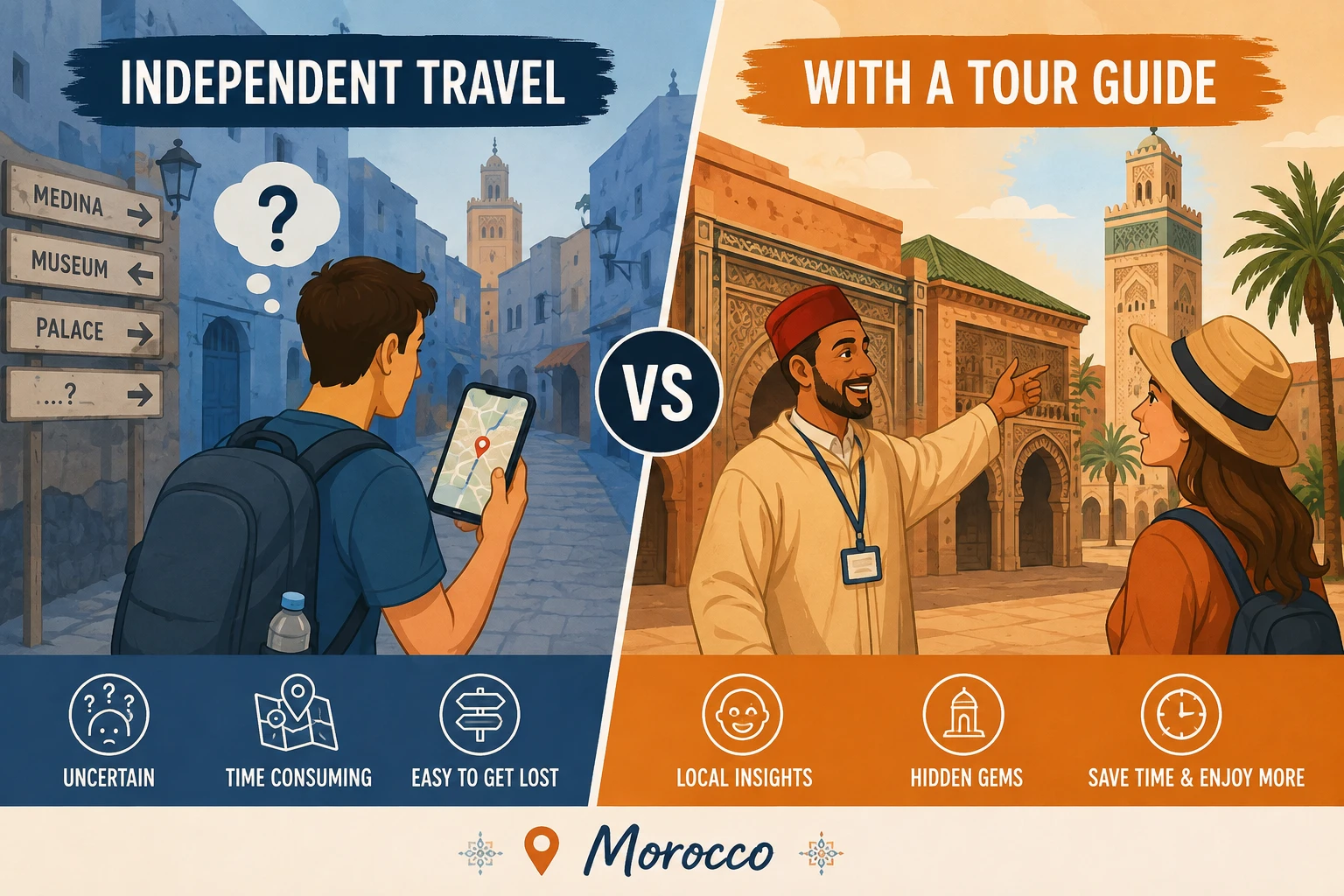
Lean independent when
- Your route sticks to Casablanca, Rabat, and coastal towns
- You enjoy figuring things out and are comfortable with ambiguity
- Budget matters more to you than time
- You already speak French or Arabic
Bring in a guide when
- Your route includes the Fes or Marrakech medina
- You are heading into the Sahara or the Atlas Mountains
- You are traveling with children, older relatives, or a tight schedule
- You want context, not just sightseeing: history, architecture, craft traditions
Most travelers land somewhere in between, guided where it counts, independent where it does not. If you have already decided a guide makes sense and are now weighing a private guide against a shared group tour, we have laid out that comparison separately in private versus group tours in Morocco.
Is Hiring a Guide in Morocco Worth the Money?
Compared with guided tours in many other countries, a private tour guide in Morocco is genuinely affordable, priced by the day rather than the hour in most cities, and modest next to what the same level of expertise would cost back home. Desert circuits and multi-day mountain routes cost more simply because they include transport, fuel, and overnight logistics, not because the guiding itself is expensive.
The value shows up in ways that are easy to underestimate before the trip and obvious afterward: no wasted mornings retracing wrong turns, no inflated souk prices because you had no local reference point, and no wondering whether the man offering to help you find your riad actually works for anyone. Ask any operator for a specific quote before you travel. Our own team is happy to send exact rates for your dates and group size, since pricing depends on the city, the season, and how many people are traveling with you.
When Should You Hire a Private Guide?
A few situations come up again and again among travelers who end up glad they booked a guide.
- It is your first time in Morocco and you have less than a week
- You are traveling with young children or older relatives
- You want to go beyond the postcard stops: ateliers, family riads, working souks
- Your trip includes the Sahara or a mountain crossing
- You are visiting during Ramadan and want the rhythm of the day explained, not guessed at
- Photography is a priority and timing matters: light, crowds, market hours
None of these situations require a guide by law or logistics. Plenty of people manage without one. But each one is a point where a Morocco travel guide with local roots tends to turn a good trip into a considerably better one.
Is It Safe to Explore Morocco Alone?
Morocco is a genuinely safe country to explore, including for solo and independent travelers, and violent crime against tourists is rare. The friction most visitors actually run into is smaller and more specific: someone offering unsolicited help finding your riad who then expects payment, a petit taxi driver who “forgets” to agree on a fare before you get in, or a persistent shop owner who will not take a polite no for an answer near a medina entrance.
None of that is dangerous. It is just tiring, and it is almost entirely avoidable once you know the pattern. Agree on taxi fares before the doors close, be firm and friendly with anyone who approaches you unprompted near Jemaa el-Fnaa or Bab Boujloud, and remember that a real licensed guide will show you an official badge without being asked. Traveling with a guide removes this category of friction almost entirely, which is often the biggest quality-of-life difference travelers notice, more than the historical facts or the shortcuts.
How to Book a Guide, Before or After You Land
Booking a guide before you travel is the more reliable route, especially in spring and autumn when demand is highest, because it lets you match a licensed local guide to your language, your interests, and your exact dates rather than whoever happens to be available at the medina gate that morning. That said, arranging one after you land is entirely possible too. Most riads and hotels can call a licensed guide within the hour, and reputable local operators take same-day requests when guides are free.
Whichever route you choose, ask to see the guide’s official license before the tour starts. Every legitimate guide in Morocco carries one. If your plans also involve moving between cities, pairing a guide with licensed private transport keeps the whole trip in trained, accountable hands rather than split across strangers you met that morning. If you would rather skip the planning entirely, our team can put together the right guide and route for your dates. Just get in touch and tell us what you have in mind.
Frequently Asked Questions
A few quick Morocco travel tips and answers to the questions we hear most often.
1- Do I need a tour guide in Morocco?
Not everywhere, but in the medinas of Marrakech and Fes, in the Sahara, and on Atlas Mountains routes, a licensed local guide makes a real difference. Straightforward city-to-city travel is comfortable to handle independently.
2- Is Morocco easy to travel without a guide?
For the main train and bus corridor between cities, yes. It gets noticeably harder once you are inside a historic medina, on a desert piste, or on an unmarked mountain trail, where local knowledge matters more than a map app.
3- Is hiring a guide in Morocco worth the money?
Most travelers who try it say yes. A private guide is priced by the day in most cities, modest compared with similar expertise elsewhere, and the time and hassle it saves usually outweighs the cost.
4- Can I visit Marrakech without a guide?
You can, and plenty of people do, but the medina’s souks and alleys are genuinely disorienting. A guide for even a single morning tends to save far more time than it costs.
5- Do I need a guide for Fes Medina?
Fes el Bali is larger, older, and more maze-like than Marrakech’s medina, with no cars allowed inside. Most visitors, independent-minded or not, end up glad they booked a local guide here.
6- Is it safe to explore Morocco alone?
Yes, violent crime against tourists is rare. The real friction is smaller things like unsolicited “helpers” or taxi fares not agreed upfront, both easy to avoid once you know to expect them.
7- How much does a tour guide cost in Morocco?
City guides are typically priced by the day rather than the hour, and desert or mountain routes cost more because they include transport and logistics. Rates vary by season and group size, so it is worth asking a licensed operator for an exact quote.
8- What are the benefits of a local guide?
Faster, safer navigation through medinas and deserts, access to artisans and family riads you would otherwise walk past, protection from overcharging and unlicensed touts, and real context for what you are looking at. That is the core value of a Morocco tour guide over navigating alone.
9- When is a private guide recommended?
Most often on a first visit, with children or older relatives, on any Sahara or Atlas Mountains leg, or whenever you want real context rather than just the postcard stops.
10- Can I book a guide after arriving in Morocco?
Yes, most riads and hotels can arrange one within the hour, and local operators take same-day requests. Booking in advance simply guarantees a licensed guide matched to your language and interests, especially in high season.