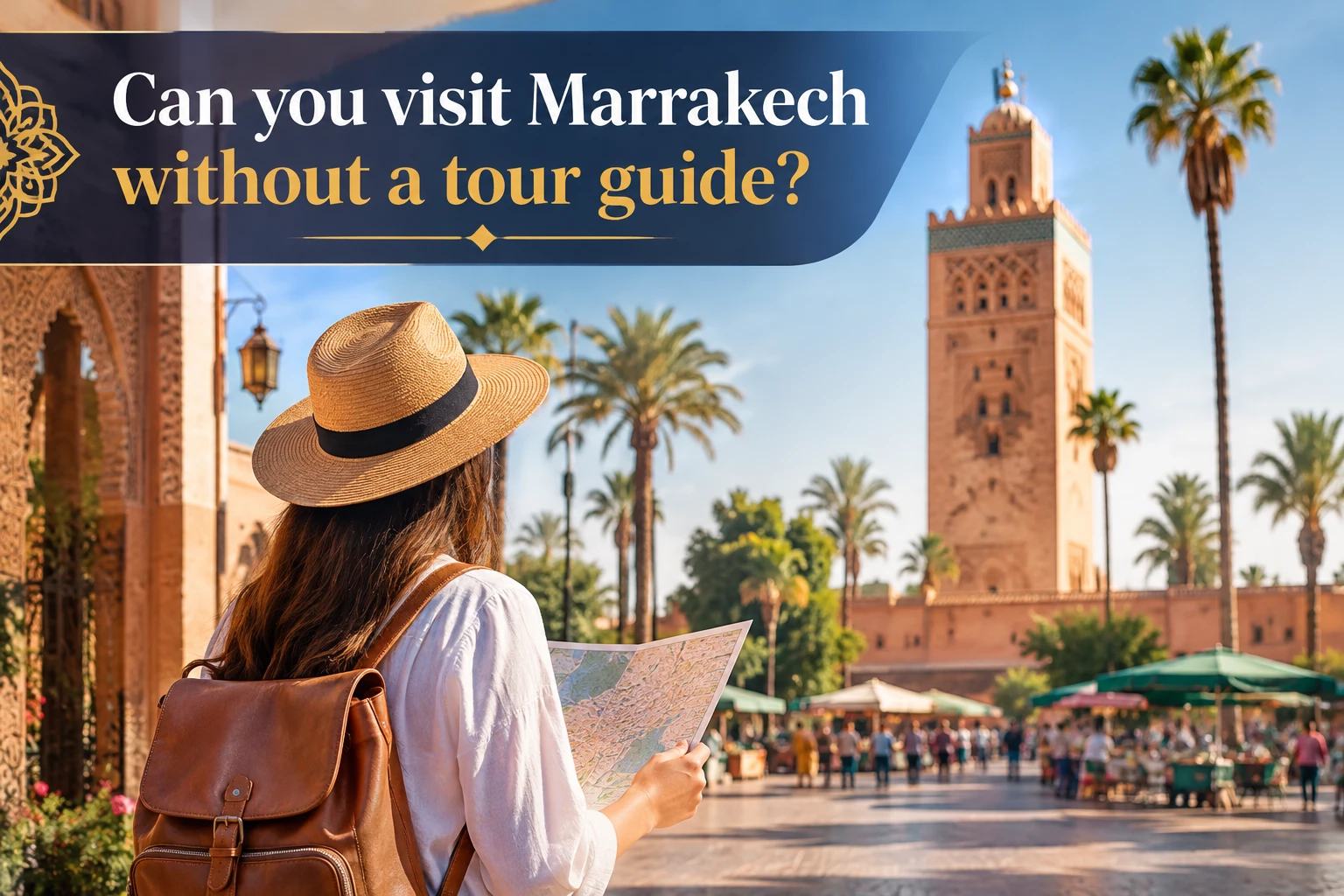
Can you visit Marrakech without a tour guide?
Marrakech Travel Guide · Updated for 2026
Picture this: you step out of your riad at sunrise, the Koutoubia’s call to prayer still drifting over the rooftops, and instead of waiting on a scheduled group tour, you simply start walking. Can you visit Marrakech without a tour guide? Absolutely, and for a great many travelers it turns out to be the most memorable way to fall for the Red City. Marrakech rewards curiosity. Its winding medina, its spice-scented souks, its palm-lined avenues all invite you to wander at your own pace, with no itinerary dictated by anyone but you. This guide walks through exactly what independent travel in Marrakech looks like: what’s genuinely easy to do alone, where a local guide still earns their keep, and how to stay safe, oriented, and thoroughly charmed from your first day to your last.
Can You Visit Marrakech Without a Tour Guide? ↑
Yes, you can visit Marrakech without a tour guide, and thousands of travelers do exactly that every year. The medina’s main landmarks, Jemaa el-Fnaa, the souks, Bahia Palace, the Majorelle Garden, are all reachable on foot or by a short taxi ride, with clear opening hours and entrance fees paid directly at the door. You do not need a guide in Marrakech to see the highlights, read a map, or find your way back to your riad at the end of the day.
What changes the equation isn’t whether you can navigate the city, since you can, but how you want to experience it. A guide adds context: the history behind a carved doorway, the difference between a genuine handmade rug and a tourist copy, a shortcut through centuries of architecture that no map will ever show you. Independent travel gives you freedom instead: no fixed schedule, no group pace, the option to sit an extra hour in a café simply because the mint tea is that good. Neither approach is wrong. The right one depends on how you like to travel, and the rest of this guide will help you decide, section by section.
Is Marrakech Easy to Navigate on Your Own? ↑
Is Marrakech easy to explore on foot? Mostly, yes, once you understand its logic. The medina was never built on a grid. Its alleys curl around old family compounds, workshops and hidden courtyards, which is part of what makes walking around Marrakech’s medina so captivating, and occasionally, admittedly, disorienting.
A few things make navigating the Marrakech medina easier than first-time visitors usually expect:
- Landmarks work better than street names. The Koutoubia Mosque’s minaret is visible from much of the medina and doubles as a natural compass point.
- Jemaa el-Fnaa square functions as the city’s mental center. Most walking routes to major sights radiate outward from it.
- Riads and shops are usually known by name to neighbors rather than by formal address, so asking “where is Riad [name]?” often works better than hunting for a house number.
- Getting mildly turned around is part of the experience, not a planning failure. Locals are used to pointing tourists in the right direction, and every alley eventually opens onto a street you’ll recognize.
Can you walk around Marrakech on your own without any plan at all? You can, but a loose one, a handful of sights grouped by neighborhood, saves you from crossing the medina twice in one afternoon. That structure, more than any guide, is what actually makes Marrakech easy to navigate.
Is It Safe to Explore Marrakech Without a Guide? ↑
Marrakech is generally safe for tourists, including those exploring independently. Violent crime against visitors is rare. The more common annoyances are persistent vendors, unofficial “guides” offering unsolicited directions for a tip, and the occasional inflated taxi fare, none of which are dangerous, just mildly tiresome if you aren’t expecting them.
For solo travel in Marrakech, a few habits go a long way:
- Keep valuables in a bag worn across your body, particularly in Jemaa el-Fnaa after dark when the square fills with performers and food stalls.
- Decline offers from unofficial guides politely but firmly. A simple “la, choukran” (no, thank you) usually ends the conversation.
- Agree on a taxi fare, or insist on the meter, before the car pulls away.
- Dress modestly. It isn’t a strict requirement, but it reduces unwanted attention and shows respect in a fairly conservative city.
Independent travel in Marrakech works particularly well for couples and small groups. Solo women travelers explore the medina alone during the day without major issue, though many prefer arranging a private driver for late-evening returns, which is exactly the kind of light-touch support that bridges guided and independent travel.
Getting Around Marrakech: Taxis, Buses and Walking ↑
Getting around Marrakech doesn’t require much planning, but it helps to know your options before you land.
Walking is the only way through the medina itself, since its lanes are largely closed to cars. Taxis can’t drive through the narrower alleys, they’ll drop you at the nearest Bab (gate) instead, so factor in a short walk to your actual riad.
For trips beyond the medina, petit taxis, small, beige, metered cars, are the standard choice. Grand taxis, older and larger, handle longer routes and private excursions outside the city, running on negotiated fares rather than meters. City buses (run by ALSA) are the cheapest option by far, but their routes can be genuinely confusing for a first-time visitor, and most tourists find taxis worth the small extra cost. App-based ride-hailing services, including inDrive and Careem, have also become common in Marrakech and offer more predictable pricing if you’d rather skip negotiating altogether. Horse-drawn calèches wait near Jemaa el-Fnaa and offer a scenic, if touristy, way to see the Menara Gardens or the city ramparts.
Petit taxis are legally required to run the meter, though drivers sometimes “forget.” Say “bil compteur, s’il vous plaît” (with the meter, please) as you get in, or simply agree on a fare before the doors close.
Using Google Maps in the Medina ↑
Google Maps works reasonably well in Marrakech’s newer districts, Guéliz, Hivernage, and along the main boulevards, but inside the medina it’s best treated as a rough guide rather than gospel. Many alleys are too narrow, or too recently rebuilt, to appear accurately, and the app will occasionally route you through a dead end or a private passage.
- Download the offline map for Marrakech before you land. Medina Wi-Fi and signal can be patchy in the narrowest lanes.
- Navigate toward the nearest recognizable landmark, a well-known riad, a museum, a famous gate, rather than a precise pin, then ask a shopkeeper for the final few meters.
- Save your riad’s pin the moment you arrive, ideally with a photo of its door, since many entrances look nearly identical after dark.
- Treat walking-time estimates generously. A seven-minute walk on the app can take fifteen once you factor in the medina’s crowds and its endless, wonderful distractions.
Best Places to Visit in Marrakech Without a Guide ↑
A self-guided tour of Marrakech works especially well because its major sights are concentrated, well signposted and simple to visit independently: no reservation, no group, no fixed schedule.
Jemaa el-Fnaa Square
Yes, you can visit Jemaa el-Fnaa without a guide, and in fact it’s best experienced twice: once by day, when the orange juice carts and henna stalls set the pace, and once after sunset, when the food vendors fill the square with smoke, spice and the sound of drums. No ticket, no guide, just good timing and an appetite.
Koutoubia Mosque
Non-Muslim visitors cannot enter, but the mosque’s 12th-century minaret is worth admiring from the surrounding gardens, and it doubles as an excellent orientation point for the rest of your walk.
Bahia Palace
A short walk from the Mellah, Bahia Palace’s carved cedar ceilings and tiled courtyards are self-explanatory enough to enjoy without narration, though the modest signage does little to explain the history, so ten minutes of reading beforehand adds real depth.
Saadian Tombs
Rediscovered only in 1917 and easy to find near the Kasbah Mosque, the tombs reward an early visit; the entrance queue grows quickly once tour groups arrive mid-morning.
Majorelle Garden and YSL Museum
Ticketed, well organized and popular enough that booking online in advance is genuinely worth it. The garden’s cobalt-blue villa and cactus collection need no explanation to appreciate.
Book your Majorelle Garden slot online a day or two ahead. Same-day queues at the gate can run well over 45 minutes in high season.
Ben Youssef Madrasa
Once North Africa’s largest Quranic school, its geometric stucco and zellige tilework make it, for many visitors, the single most photogenic stop in the medina.
Grouping sights by neighborhood, Kasbah landmarks in one loop, the Mellah and Bahia Palace in another, avoids the crisscrossing that eats up hours in the medina’s dense layout.
Shopping in the Souks on Your Own ↑
Shopping in Marrakech’s souks without a guide is entirely manageable, and arguably more enjoyable without someone steering you toward specific shops for a commission.
The souks are loosely organized by trade: Souk Semmarine for textiles and leather goods, Souk el Attarine for spices and perfumes, and the ironworkers’ souk for lanterns and metalwork. Prices are rarely fixed, bargaining is expected, and opening around a third to half of the initial asking price is a reasonable, respectful move.
- Walk through once without buying. Prices soften noticeably on a second pass once a vendor has seen you browsing calmly rather than urgently.
- If an opening price feels absurd, a polite smile and a counteroffer usually recalibrates the conversation quickly.
- Argan oil, saffron and leather goods are common souvenirs; buying from a shop with visible pricing or a cooperative stamp lowers the odds of paying tourist markup for a lesser product.
- It’s fine to walk away, genuinely fine. Most vendors expect it, and a fair number will call out a better price as you go.
When It’s Worth Hiring a Local Guide ↑
Independent travel covers most of what Marrakech has to offer, but there are moments where a local guide earns their fee back many times over.
A licensed guide is worth considering when:
- You want the history, not just the view. A guide can explain the symbolism behind a zellige pattern or the origins of a building in a way no plaque ever will.
- You’re visiting during Ramadan or a major local holiday, when opening hours shift and a local’s real-time knowledge saves wasted trips.
- You’d rather not haggle. A guide who knows fair local pricing can smooth negotiations in the souks considerably.
- Your time is genuinely limited, a day or two, and you’d rather have the highlights covered efficiently than discovered by trial and error.
- You’re planning a day trip into the Atlas Mountains or the Agafay desert, where a guide with licensed transport handles both the route and the local context.
That’s really the honest answer to “should I hire a guide in Marrakech”: it’s less about needing one to survive the city, and more about what kind of depth and convenience you want from your time here.
How Many Days Do You Need in Marrakech? ↑
Three to four days is enough to see Marrakech properly without rushing: one day for Jemaa el-Fnaa and the souks, one for the palaces and museums (Bahia Palace, Saadian Tombs, Ben Youssef Madrasa), and one for the Majorelle Garden and Guéliz’s cafés and galleries.
If your schedule only allows two days, focus on the medina’s core sights and accept a brisker pace. Travelers with five days or more can comfortably add a day trip: the Atlas Mountains for Berber villages and mountain air, the Agafay desert for a sunset camp experience closer to the city than the Sahara, or Essaouira for a coastal change of scene.
First-Time Visitor Tips ↑
A handful of practical habits make a first visit to Marrakech noticeably smoother:
- Carry small dirham notes. Vendors, taxis and calèche drivers rarely have change for large bills.
- Learn a few words of Darija or French. “Choukran” (thank you) and “la, choukran” (no, thank you) go a long way with persistent vendors.
- Pack layers. Marrakech’s climate means warm days and noticeably cooler evenings, even in summer.
- Save your riad’s exact location offline and photograph its street entrance the moment you check in.
- Expect the medina to feel dense and sensory. That isn’t a flaw to plan around, it’s genuinely most of the appeal.
- Keep your first day light. Jet lag and the afternoon heat combine into an early evening more often than travelers expect.
Whether you explore Marrakech entirely on your own or bring in a local guide for a single day, the choice comes down to the kind of trip you want, not a test you need to pass.
If you’d like the option of a licensed local guide or private, permitted transport for part of your stay, without committing to a fully guided trip, Distinctive Experience arranges both on a flexible, as-needed basis across Marrakech and beyond.
Plan Your Marrakech ExperienceFrequently Asked Questions ↑
Is Marrakech safe for tourists?
Yes. Violent crime against visitors is uncommon, and most safety concerns involve minor scams or persistent vendors rather than genuine danger. Standard city precautions apply, as they would in any major destination.
Do you need a guide in Marrakech Medina?
No. The medina’s main sights are walkable and well signposted enough to visit independently. A guide adds historical context and can save time, but it isn’t required to get around.
Can you walk around Marrakech alone?
Yes, and it’s a common way to explore the city, particularly during daylight hours. Solo travelers walk the medina regularly, using landmarks like the Koutoubia Mosque and Jemaa el-Fnaa to stay oriented.
Is Marrakech easy to navigate?
It’s easy once you learn to navigate by landmark rather than street name, since the medina’s alleys weren’t built on a grid. A loose, neighborhood-by-neighborhood plan makes it considerably simpler.
What are the benefits of hiring a local guide?
A guide adds historical and cultural context, can help with fair pricing in the souks, and is especially useful for day trips outside the city or during holidays when opening hours shift unpredictably.
Is Marrakech good for solo travelers?
Generally, yes. Solo travelers, including solo women, explore the medina independently during the day without major issue, though arranging a private driver for late evenings is a common and sensible precaution.
How many days do you need in Marrakech?
Three to four days covers the city’s main sights comfortably. Two days works for a brisker visit, while five or more allows for a day trip to the Atlas Mountains, the desert or Essaouira.
What should first-time visitors know before visiting Marrakech?
Carry small dirham notes, dress modestly, expect to bargain in the souks, and keep your first day light to adjust to the heat and the medina’s sensory pace.
Can you visit Jemaa el-Fnaa without a guide?
Yes. The square is open to everyone, free to enter, and best visited independently, once during the day and again after sunset when the food stalls and performers take over.