Merzouga quad biking & buggy adventure: Prices, routes, and safety tips
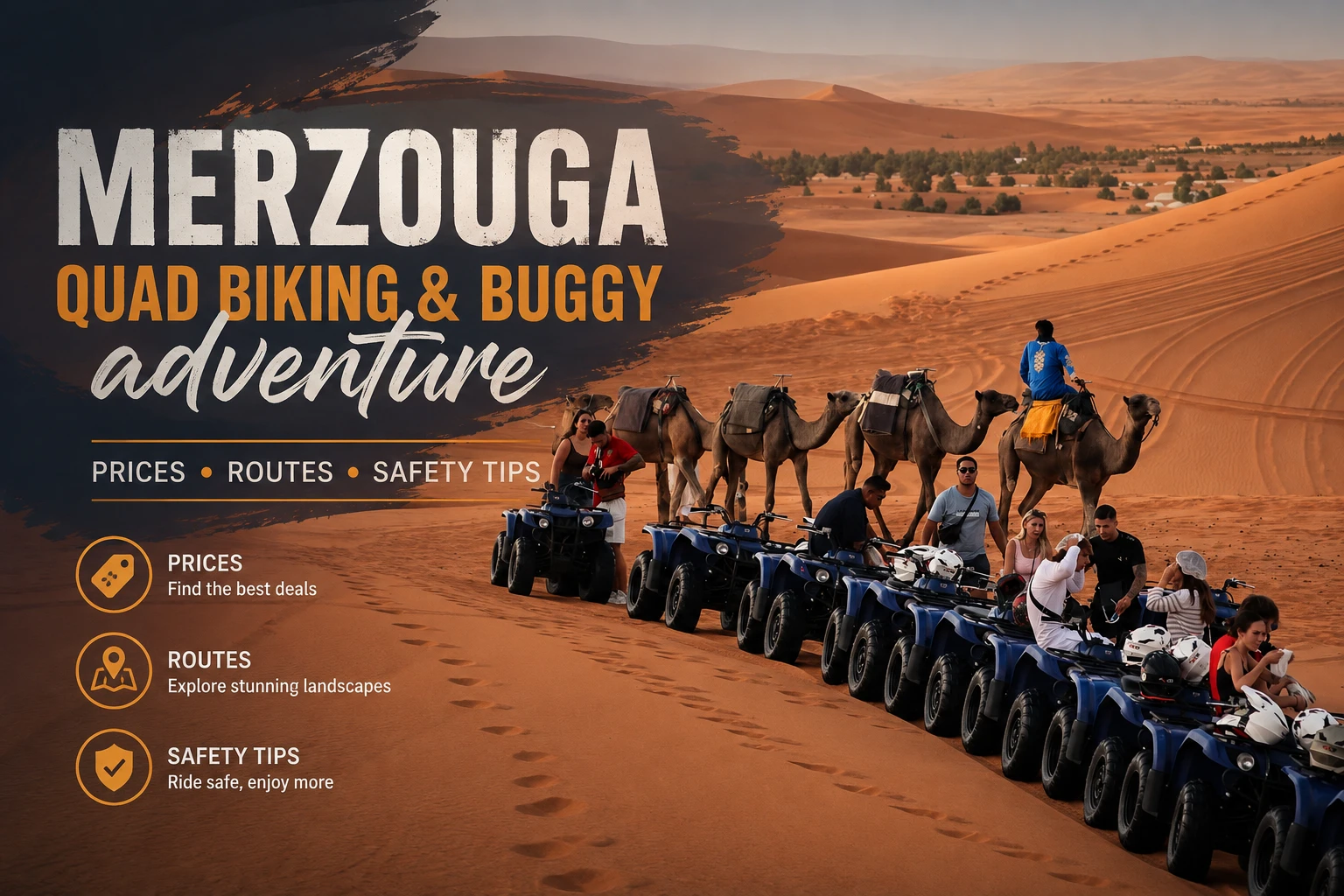
Leave the village at seven in the morning and the sand is still cool and firm, the air smells faintly of woodsmoke, and the western face of Erg Chebbi is one long shadow. That first half hour is the reason Merzouga quad biking has become the activity most travellers end up booking twice during the same stay. This guide is a practical look at what quads Merzouga operators actually charge in 2026, which routes suit which kind of rider, how a buggy compares to an ATV, and the safety habits that separate a brilliant morning from an expensive one.
Everything below is written from the perspective of people who live at the edge of these dunes rather than from a brochure. Prices are given as realistic ranges, because rates in Merzouga move with the season, the size of your group, and the machine you end up on.
Why Erg Chebbi is such good riding ground ↑
Erg Chebbi is a sand sea roughly twenty two kilometres long and five wide, with crests that rise close to 150 metres above the flat hamada around them. What makes it unusual for riding is the variety packed into a small area. Within twenty minutes of the village you can move from hard gravel plain to fine dune sand, past a dry seasonal lake, along the palm line of Hassilabied, and out towards the black volcanic desert that stretches south. You are never on the same surface for long, which is what keeps a Merzouga ATV tour interesting even for people who came mainly for the photographs.
The other advantage is space. Away from the main track there is no traffic, no fences and no queue, so a guided quad tour in Merzouga can be paced entirely around your group. Riders who want speed get open corridors between the dunes. Riders who want scenery get long stops on ridges where the whole erg opens up in front of them.
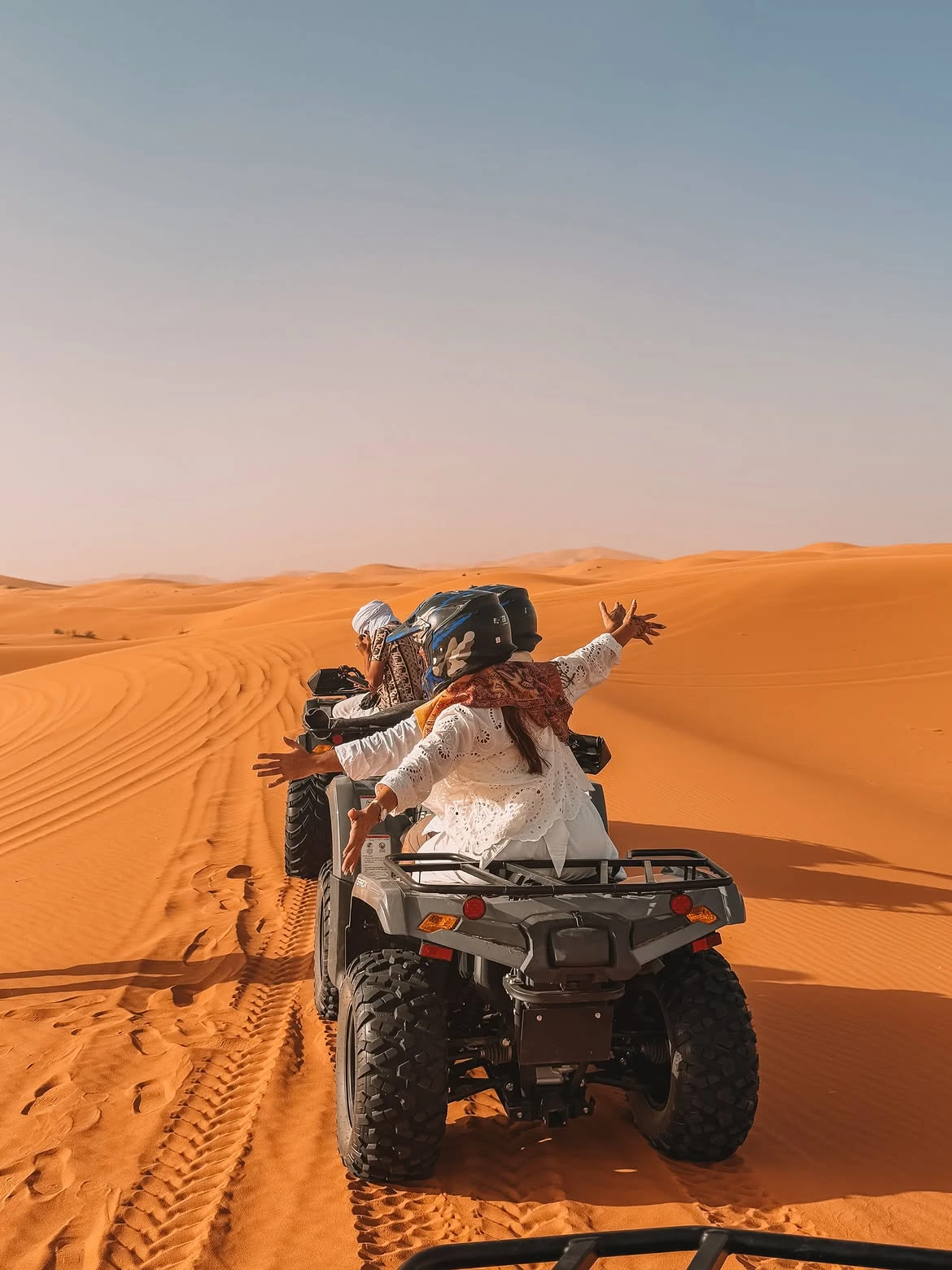
Quad biking in Merzouga: the first minutes on the sand, filmed near the western edge of Erg Chebbi.
Quad or buggy: how to choose ↑
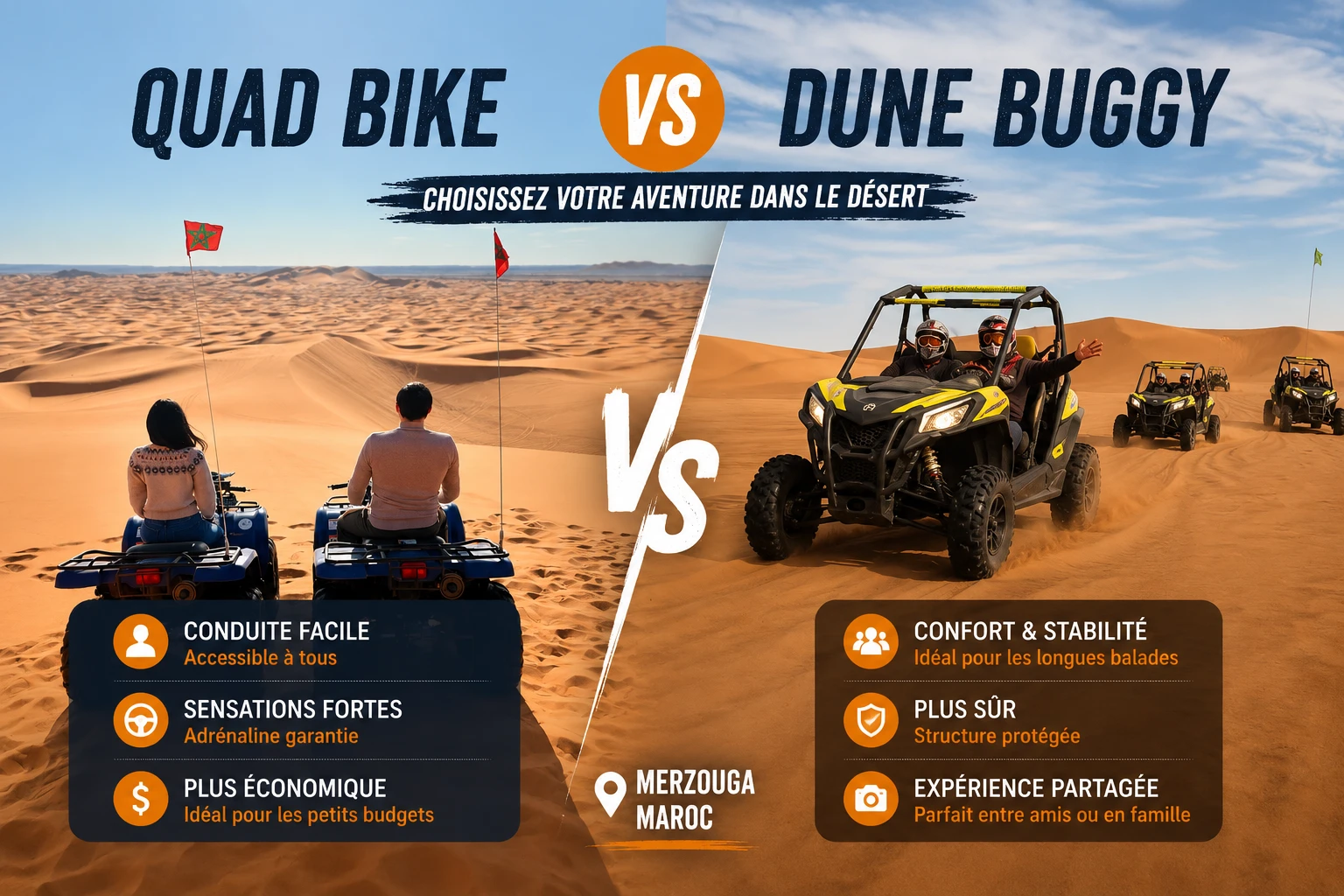
This is the first real decision, and it changes both the price and the feel of the day. A quad, or ATV, is a single seat machine you straddle. Almost every quad rented in Merzouga is automatic, with a thumb throttle and no gears to think about, which is why no previous experience is needed. You feel the terrain directly, you get sand on you, and you steer with your weight as much as with the bars.
A buggy is a small off road car with a roll cage, bucket seats, harnesses and either two or four places. You sit low, you steer with a wheel, and one person drives while the others ride along. For couples, for a parent riding with a child, or for anyone who does not want to handle a machine alone, the Merzouga desert buggy is the easier choice. It is also more forgiving in soft sand, because four wide wheels float better than two.
Pick a quad if
- You want the physical side of the ride and do not mind dust and effort.
- You are travelling solo, or with friends who each want their own machine.
- Budget matters, since ATV rental is consistently the cheaper of the two.
Pick a buggy if
- You are two or four people and would rather share one vehicle.
- You want a family friendly buggy tour in Merzouga where a child can sit belted next to an adult.
- You prefer a seatbelt, a cage and a steering wheel to balancing on a moving seat.
- You have back or wrist problems that would make an hour on a quad uncomfortable.
Merzouga quad biking prices in 2026 ↑
Merzouga quad biking prices are quoted either per person or per machine, and the difference matters when you compare offers. The ranges below reflect what established local operators ask in 2026 for guided rides with equipment included. Rates soften in the hot months of July and August, then firm up around Easter, the autumn peak and the end of December.
| Duration | Typical price | Roughly in dirhams | What it usually covers |
|---|---|---|---|
| 1 hour | 25 to 40 euros | 270 to 430 MAD | Dunes closest to the village, one photo stop |
| 2 hours | 40 to 65 euros | 430 to 700 MAD | Erg Chebbi edge, Khamlia or the dry lake, tea stop |
| Half day, 3 to 4 hours | 60 to 95 euros | 650 to 1,020 MAD | Black desert, old mines, nomad visit, longer riding |
| Full day | 100 to 160 euros | 1,080 to 1,720 MAD | Deep desert loop plus lunch with a local family |
| Multi day | from 150 euros per day | from 1,600 MAD per day | Riding, support vehicle, camp or guesthouse night |
Two factors move the Merzouga quad tour price per person more than anything else. The first is group size, since fuel, guide and support are shared and a group of six will always pay less each than a couple. The second is whether you ride solo or double. Some operators seat two people on one quad for a small supplement, which is fine on flat sand but far from ideal on steep dunes.
On bargaining. Prices in Merzouga are negotiable in the street and much less so with established operators who insure their machines and pay trained guides. A quote that sits far below every other one is usually short on something you cannot see, most often insurance, helmet quality or the age of the fleet.
Merzouga buggy tour prices ↑
A buggy costs noticeably more than an ATV. The machines are more expensive to buy, they burn more fuel, and they take more maintenance after a season in the sand. The useful comparison is per vehicle rather than per head, because two or four people share the same buggy and the cost per person falls quickly.
| Duration | Two seat buggy | Four seat buggy | Notes |
|---|---|---|---|
| 1 hour | 90 to 130 euros | 140 to 190 euros | Short dune loop, ideal for sunset light |
| 2 hours | 140 to 200 euros | 200 to 280 euros | Adds Khamlia, the oasis or the black desert |
| Half day tour | 200 to 300 euros | 280 to 400 euros | Three to four hours with stops and tea |
| Full day | 320 to 480 euros | 420 to 600 euros | Long loop south, lunch usually included |
Split four ways, a half day Merzouga dune buggy experience often lands close to the cost of individual quads, which surprises visitors who assume buggies are only for large budgets. If you are two, the quad stays cheaper. If you are four, run the numbers before deciding.
What the price includes, and what it does not ↑
Read any quote as a list of items rather than a single number. In Merzouga the following are normally part of a guided ride.
- Fuel for the whole route, topped up before departure.
- Helmet, goggles or a visor, gloves, and often a scarf against the dust.
- A briefing on the controls plus a short practice loop on flat ground.
- A guide riding ahead of the group for the entire tour.
- Pick up from your hotel or camp inside the Merzouga and Hassilabied area.
- Tea or a soft drink on longer routes, and lunch on full day tours.
What is frequently excluded, and worth settling before you pay, is the damage policy. Most operators hold you responsible for a rollover that bends bodywork, and some ask for a deposit or a copy of your passport. Ask what happens mechanically as well. A serious company sends a support vehicle or a second guide when a machine stops, rather than leaving you to wait in the sun.
Routes: where you actually ride ↑
Merzouga quad biking routes are not fixed trails. Guides read the wind, the recent traffic and the firmness of the sand, then link a series of known points. These are the combinations you will be offered most often.
The one hour loop
North of the village towards Hassilabied, along the western dune line, up to a low ridge for the view, and back. It is short, it is the cheapest Merzouga ATV rental option, and it is enough to know whether you want more.
Two hours towards Khamlia and the dry lake
South along the base of the erg to Khamlia, the village founded by descendants of Sub Saharan families and known for its Gnawa music, then back past Dayet Srji, the seasonal lake that fills after heavy rain and draws flamingos in spring. This is the best value Merzouga off road tour for most visitors.
Half day into the black desert
West and south onto the hamada, a hard dark plain of volcanic stone that feels like another planet after the golden sand, with a stop at the abandoned mining settlements near Mifis and often tea with a nomad family camped in the area.
Full day and multi day
Longer loops reach Erg Znigui, the quieter dune field east of the main erg, and the palm groves and fossil beds towards Taouz. Multi day Sahara quad biking Morocco itineraries add a night in a camp, with luggage carried by a 4×4 so you ride light.
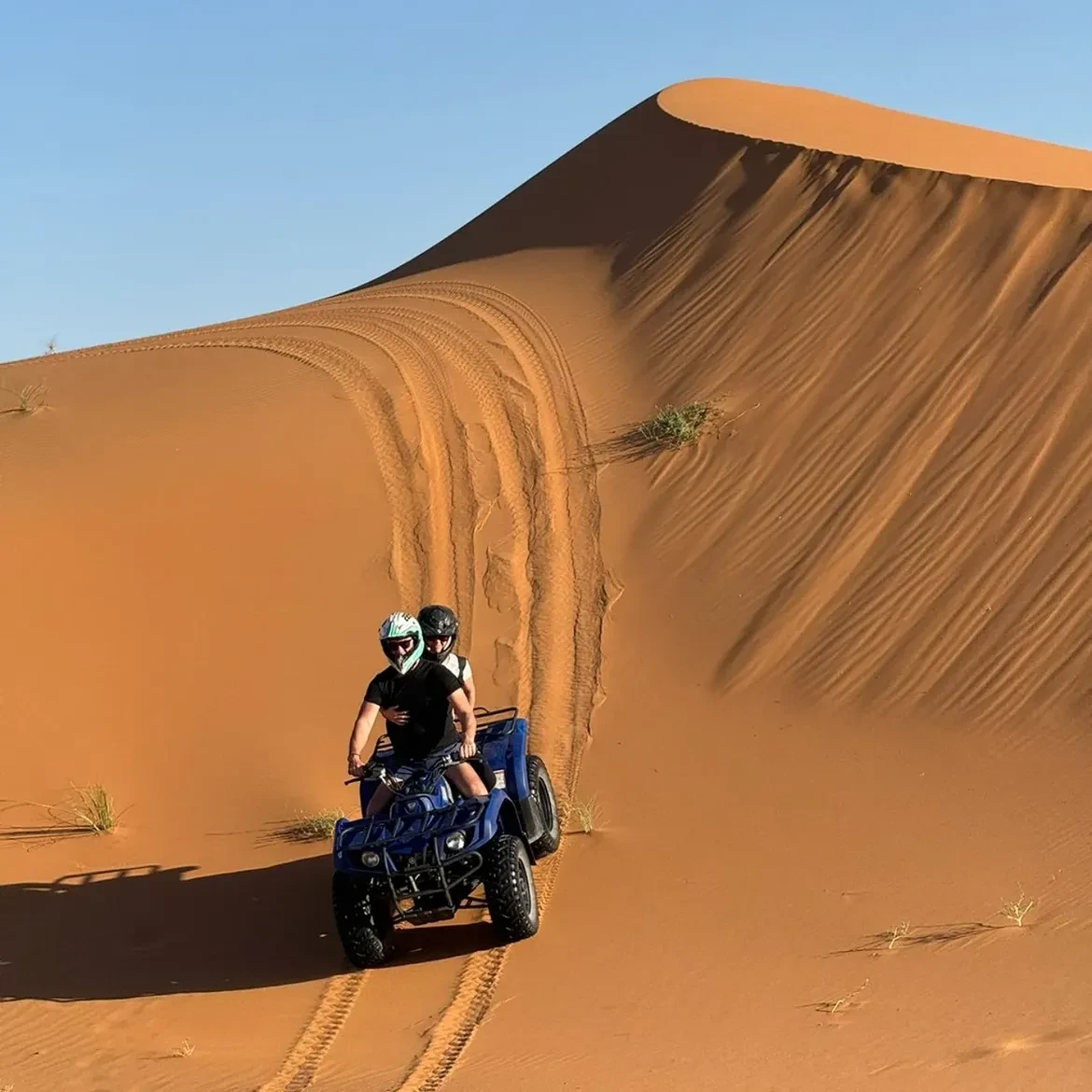
The view from a quad tour along Erg Chebbi, where the dune line changes colour through the afternoon.
Sunrise, sunset, and the right season ↑
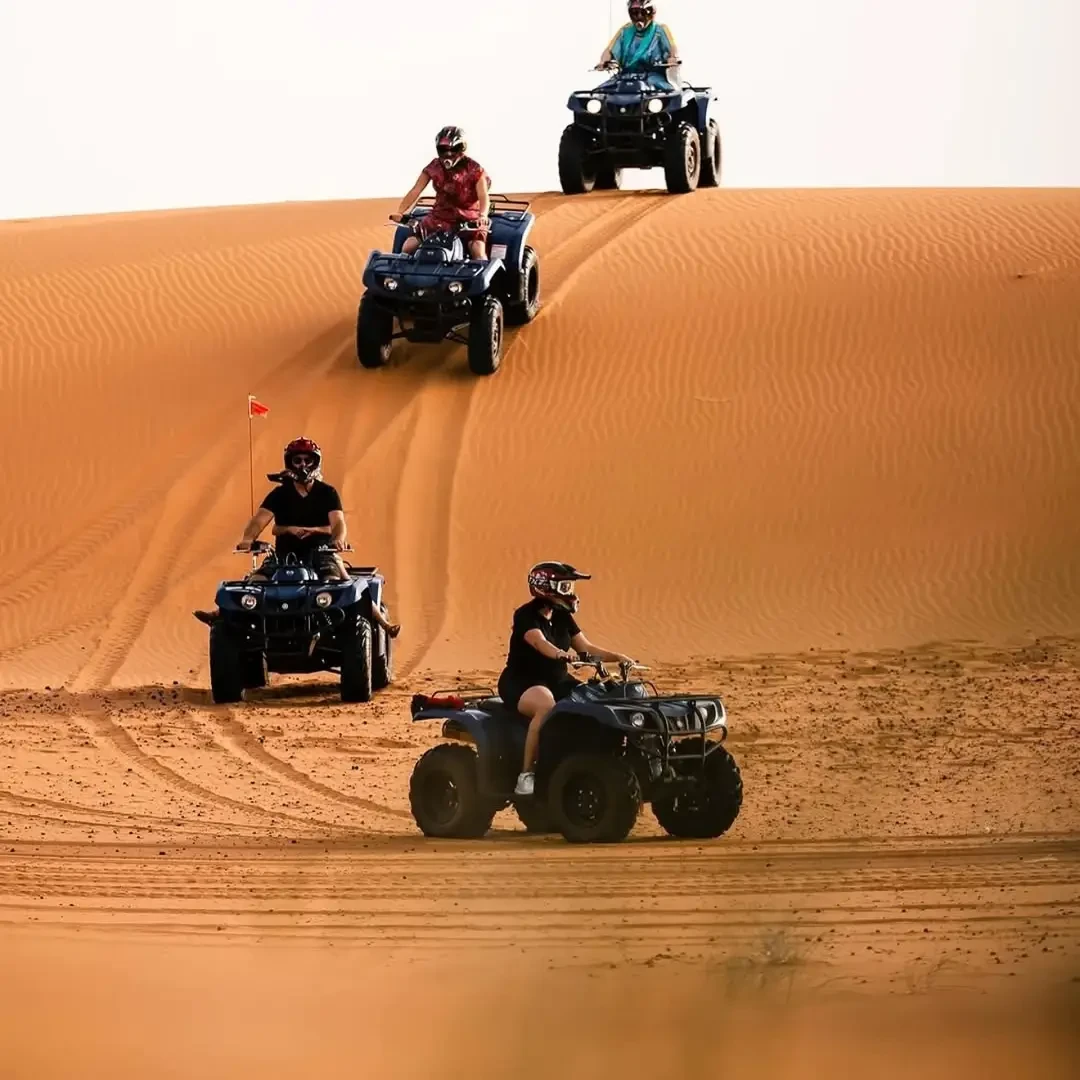
Time of day matters more here than almost anywhere else. Sunrise buggy tour and sunset quad biking Merzouga slots exist for a practical reason as much as a photographic one: the sand is cooler, the light is low enough to show the shape of every ridge, and midday glare flattens the dunes into a blank sheet.
From June to early September the middle of the day is genuinely hostile, with air temperatures above 45 degrees and sand far hotter. Serious operators simply do not ride between roughly eleven and five in summer. From October to April the timing opens up, mornings are crisp, and an afternoon ride finishing at sunset is the classic choice. Spring brings occasional sandstorms that can cancel a tour at short notice, so keep a little flexibility in your schedule.
Safety gear and the briefing that matters ↑
Is quad biking safe in Merzouga? It is, on the condition that the equipment is real and the guiding is competent. Most incidents here come down to three things: riding without a guide, riding too fast on unfamiliar dunes, and taking a slope sideways. All three are avoidable.
A proper helmet is not optional. Check that it fits snugly, that the strap works, and that the shell is not cracked from a previous fall. Goggles or a visor matter just as much, because dust and blown sand will find your eyes within minutes at speed. Gloves protect your palms on the thumb throttle and save your hands if you put them down in hot sand.
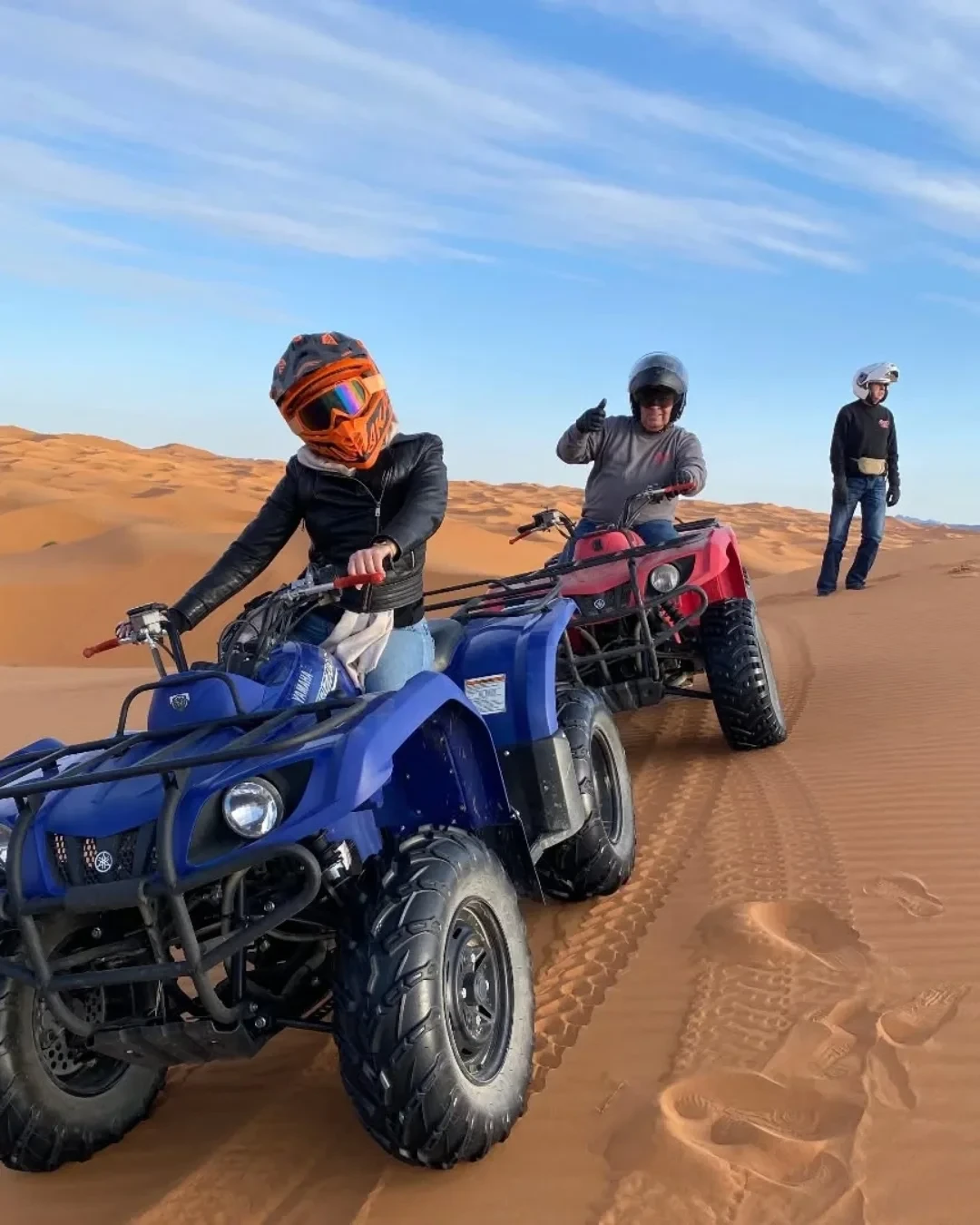
The briefing should cover the throttle, the brakes, how to restart if the engine cuts on a slope, and the hand signals your guide will use. If nobody explains any of that and you are simply pointed at a machine, treat it as a warning sign worth acting on.
Riding technique on soft sand ↑
Desert driving safety rests on a handful of habits that guides repeat all season.
- Keep steady momentum. Sand punishes hesitation far more than speed, and stalling halfway up a slope is how most people get stuck.
- Climb and descend straight up or straight down the fall line. Crossing a steep slope sideways is the single most common cause of a rollover.
- Never crest a dune blind. The far side is often much steeper than the side you climbed, so ease off before the top and look over first.
- Ride in the guide’s line rather than beside it. He knows where the sand is firm and where a hidden dip waits.
- Hold a gap of four or five machine lengths. Dust hangs in still air and you can lose sight of the rider ahead in a second.
- Shift your weight forward when climbing and back when descending, and stand slightly on the pegs over rough ground.
- If you feel the machine tipping, step off on the uphill side rather than trying to hold it. Bodywork is repairable, ankles are less so.
What to wear ↑
Sand gets everywhere, so dress for it rather than for photographs. Closed shoes are the one item with no alternative, since sandals leave your feet exposed to hot metal and hotter sand. Long sleeves and long trousers protect you from the sun and from the exhaust when you climb off. A light scarf or buff over the nose keeps most of the dust out of your throat.
Sunglasses are useful at the stops but not while riding, where goggles do a much better job. Bring sunscreen, a litre of water per person even on a short ride, and a small strap for your phone or camera if you plan to shoot from the machine. In winter a fleece is welcome, because a moving quad at eight in the morning in January is genuinely cold until the sun clears the dunes.
Families, children, and private rides ↑
Families have two workable options. Younger children ride as passengers in a four seat buggy driven by a parent or by the guide, which keeps everyone together and belted. Teenagers are often allowed on their own quad on flat sections at the guide’s discretion, with a slower pace and a shorter route.
A private quad tour costs more per person but earns its keep with mixed abilities in the group, because the pace follows the slowest rider instead of the fastest. It also lets you stop when the light is good rather than when the schedule says so, which is the main complaint people have about large shared departures in high season.
Quad, buggy, or camel ↑
Comparing a camel ride and quad biking in Merzouga misses the point slightly, since they answer different questions. A camel trek is slow, quiet and cultural, and it is how you should arrive at a desert camp for the night. A quad or buggy covers in one hour what a camel covers in a day, reaches the far side of the erg and the black desert, and gives you the adrenaline side of the Sahara.
Most people who stay two nights do both, usually a camel trek at sunset on arrival and a Merzouga desert adventure on a machine the following morning. If you have one slot only and you want distance and variety, take the quad or the buggy. If you want silence and the classic image of the dunes, take the camel.
A local view from Merzouga ↑
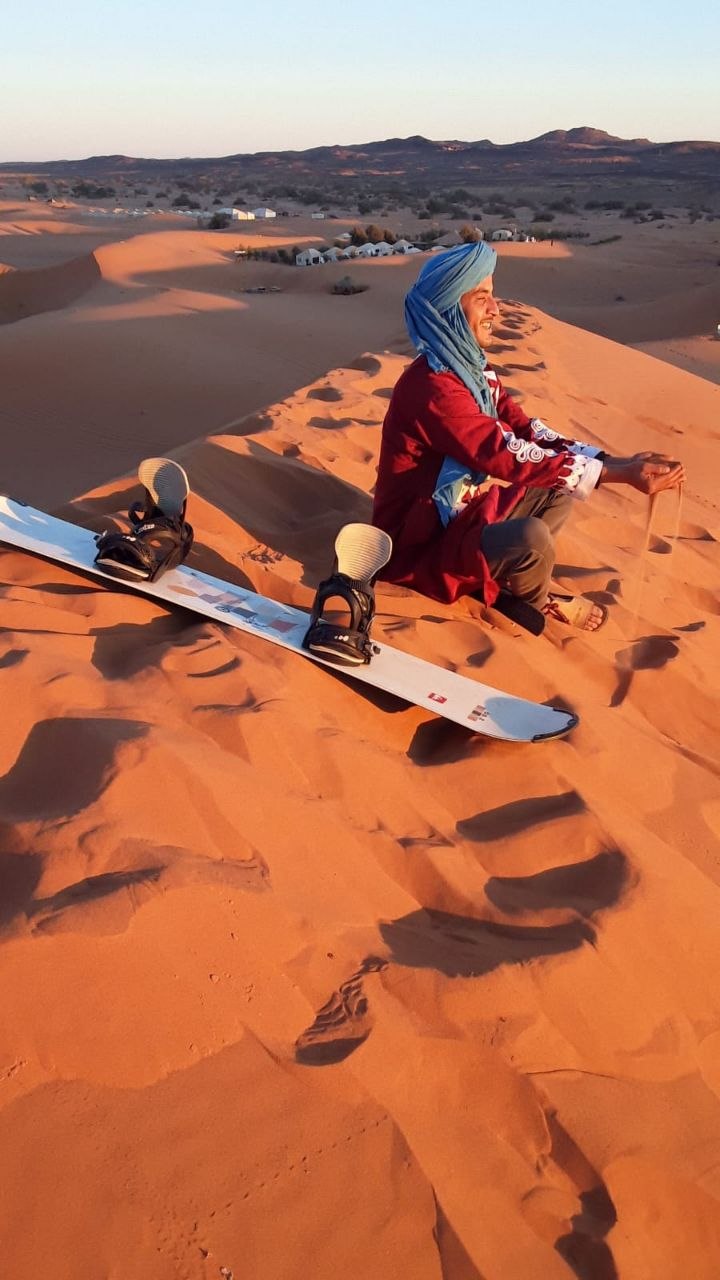
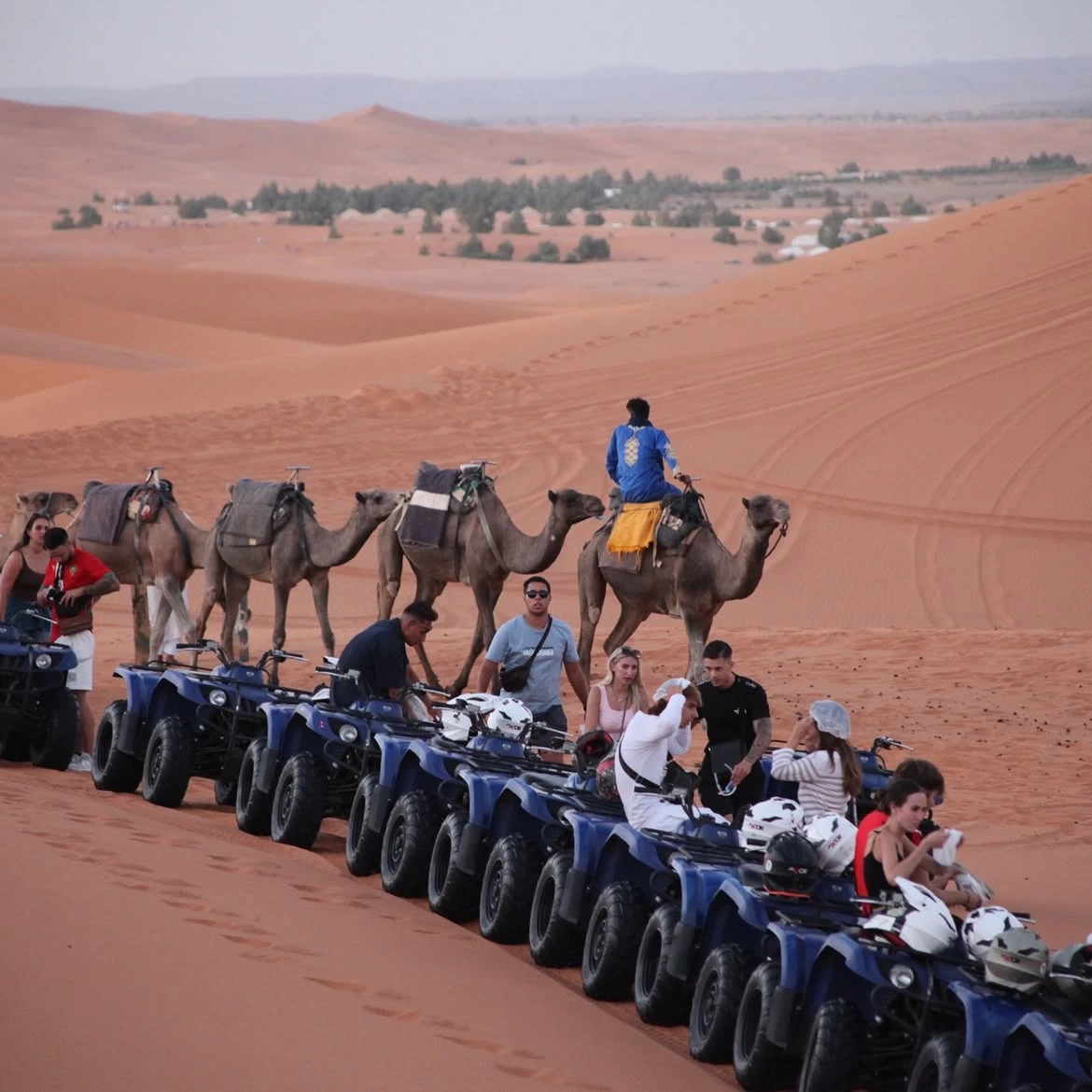
Said AIT ELKAID was born and raised in Merzouga and runs Distinctive Experience, a transport and guiding company working across southern Morocco. Growing up at the foot of Erg Chebbi means knowing which slopes hold firm after rain, which operators maintain their fleet properly, and how the routes shift from one season to the next.
His practical advice for visitors is short: ride early morning or late afternoon, look at the helmet before you agree on a price, and give yourself two hours rather than one, because almost everyone who takes the shortest option wishes they had gone further.
Local knowledge counts for logistics that have nothing to do with riding, too. Merzouga sits about 350 kilometres from Fes and 560 from Marrakech, so most travellers arrive tired after a long drive. Slotting the adventure activities in Merzouga into the morning after arrival, rather than the same evening, tends to produce a far better experience.
Frequently asked questions ↑
Do I need a driving licence for quad biking in Merzouga?
No licence is required for guided rides on open desert terrain, which is how nearly all tours operate. Machines are automatic and the briefing is designed for complete beginners. Some operators ask adults to show a passport or ID for their records.
How much does a Merzouga ATV tour cost per person?
Expect roughly 25 to 40 euros for one hour, 40 to 65 euros for two hours, and 60 to 95 euros for a half day, with equipment and a guide included. Larger groups and low season bring those figures down, while a private tour raises them.
Is a buggy safer than a quad in the dunes?
Each has its own risks. A buggy protects you with a cage and a harness, but it is heavier and can roll on a steep sideways slope. A quad is lighter and easier to step off, though you are exposed. In practice the guide’s judgement and your speed matter far more than the choice of machine.
What should I wear for quad biking in the Sahara?
Closed shoes, long trousers, long sleeves and a scarf for the dust. Add sunscreen and water in warm months, and a fleece for winter mornings. The operator supplies the helmet, goggles and gloves.
Can children join a buggy tour in Merzouga?
Yes, in a four seat buggy with an adult driving and the child belted in. Minimum ages for driving vary by operator and usually sit around sixteen, so confirm when you book if a teenager wants their own machine.
When is the best time of day for a ride?
Early morning or the two hours before sunset. The sand is cooler, the light shows the contours of the dunes, and in summer the middle of the day is simply too hot to ride safely.
Can I ride without a guide?
Some places will rent you a machine alone for a short loop near the village, but it is a poor idea. Dunes look identical from the saddle, tracks disappear with the wind, and phone coverage is patchy once you are behind the first ridge. Every reputable operator sends a guide.
How long should I book for a first ride?
Two hours is the sweet spot. One hour barely gets you past the first dune line, while two hours reaches Khamlia or the dry lake with time for a proper stop. Half and full day options make sense if you want the black desert and the quieter dune fields to the east.
Are prices quoted per person or per vehicle?
Quads are almost always quoted per person, since each rider takes one machine. Buggies are usually quoted per vehicle, so the cost per head drops sharply when four of you share one. Always ask which basis a quote uses before comparing two offers.