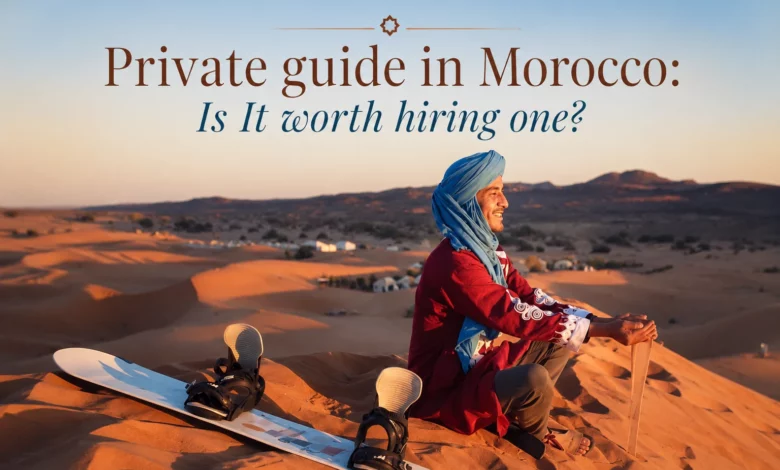
Private guide in Morocco: Is It worth hiring one?
Anyone who has stood at the entrance of the Fes medina, facing nine thousand alleys with no visible logic, understands the appeal of a private guide in Morocco almost instantly. The country rewards travelers who know where to look, and it can just as easily wear down those who are figuring it out alone. This guide breaks down what a private guide actually does, how the experience compares to a group tour, what it costs, and how to decide whether it makes sense for your own trip.

What Does a Private Guide in Morocco Actually Do?
A private tour guide in Morocco is a licensed professional who accompanies you (and only your group) through cities, monuments, and sometimes entire regions, offering historical context, cultural background, and practical navigation that a guidebook or an app simply cannot replicate in the moment. In Morocco, guiding is a regulated profession. Guides who work inside classified historic sites and medinas are trained and licensed by the Ministry of Tourism, and they carry an official badge to prove it. This matters more here than in many other countries, because access to certain monuments, and the ability to explain them accurately, is legally tied to that certification.
A local guide in Morocco typically does far more than recite dates and names. In a city like Marrakech or Fes, a good guide reads the medina the way a local reads a neighborhood: which turn leads to a dead end, which workshop is worth a stop, which riad courtyard is worth peeking into, and which vendor is trying to steer you toward a commission-paying shop. That local judgment, built over years, is really what you are paying for.
Private Guide vs Group Tour in Morocco: Key Differences
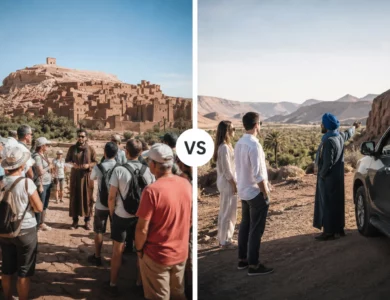
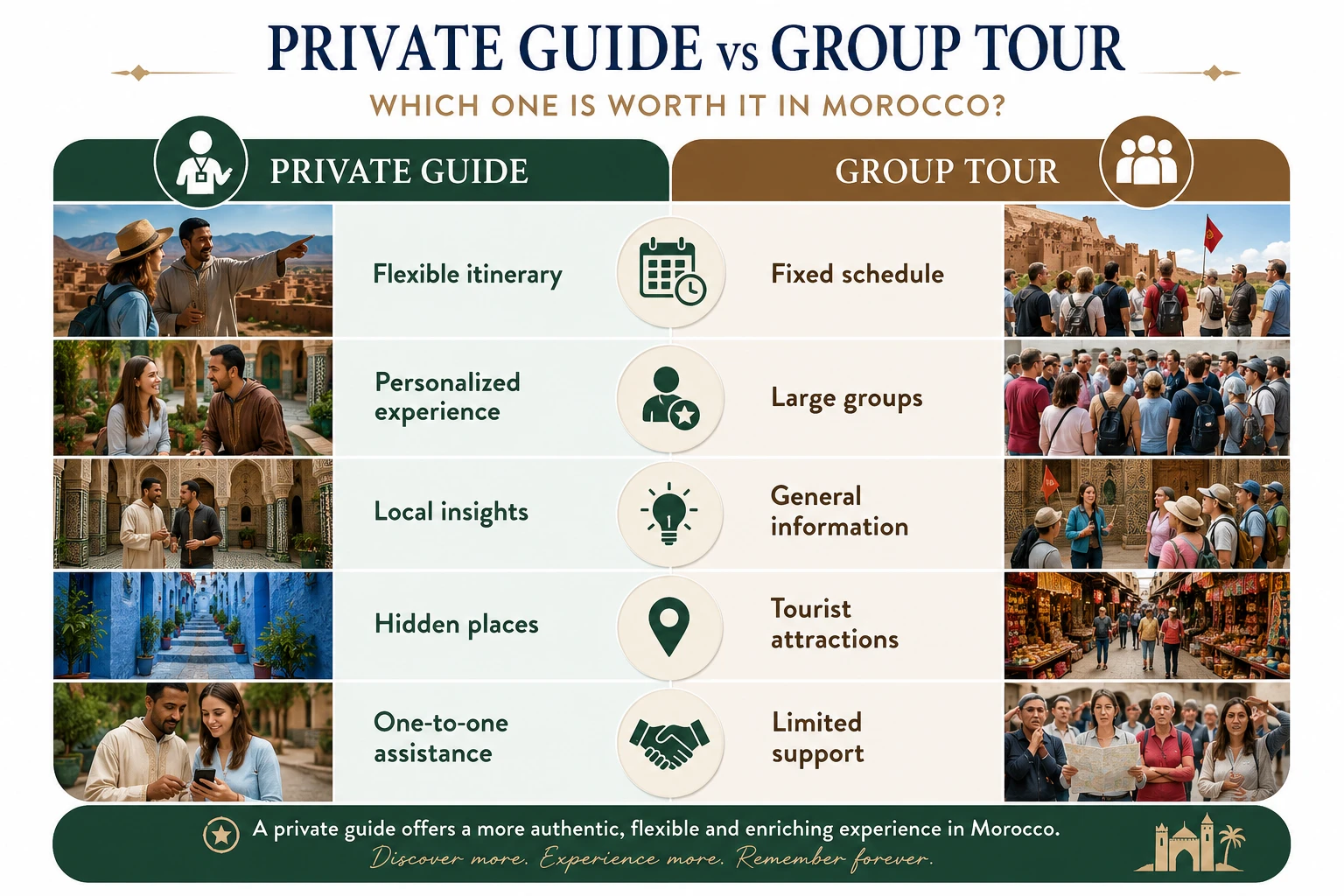
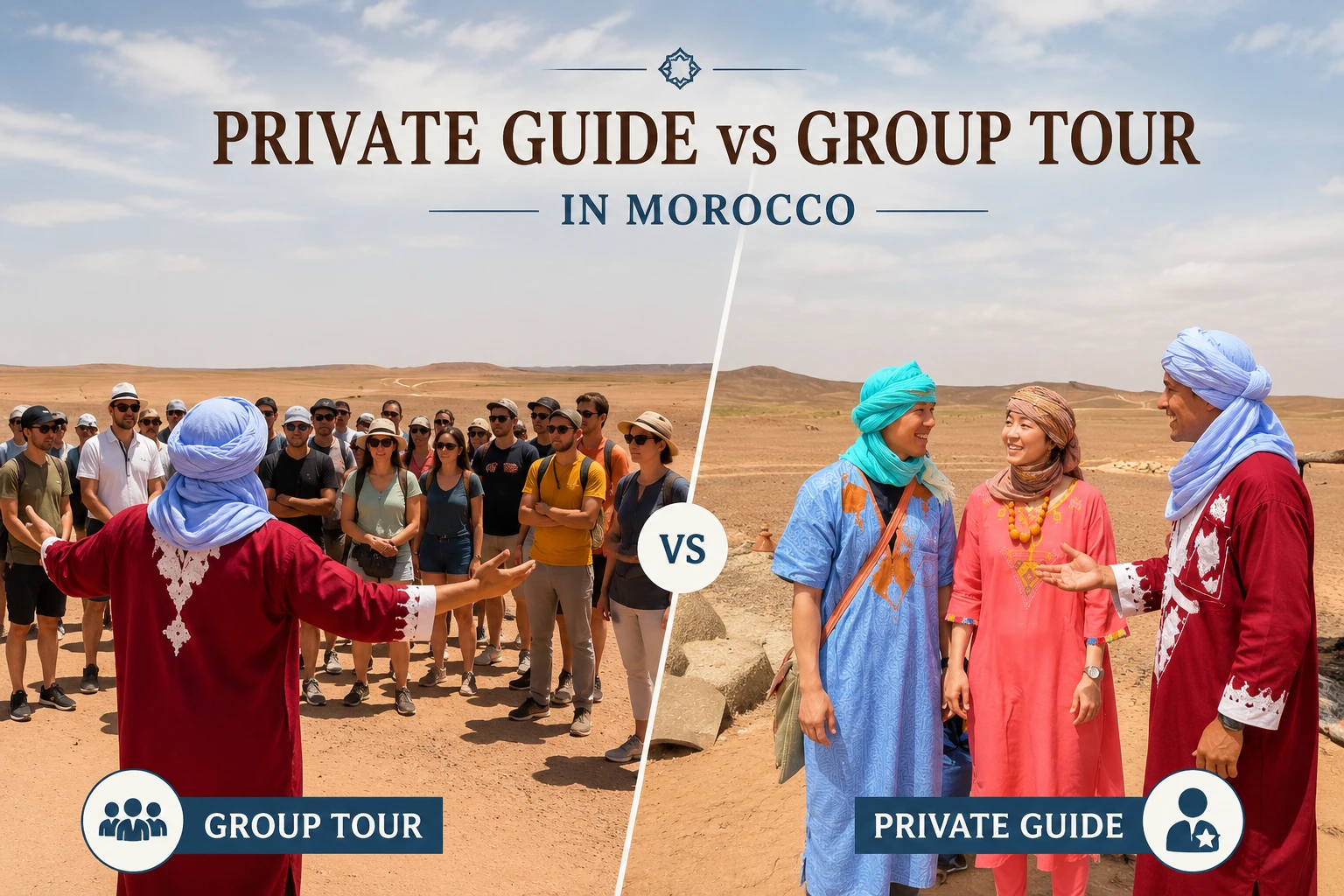
The choice between a private guide and a group tour usually comes down to pace, budget, and how much control you want over your own itinerary. Neither option is universally better. It depends on what kind of trip you are trying to have.
| Factor | Private Guide | Group Tour |
|---|---|---|
| Pace | Set entirely by you | Fixed schedule for the whole group |
| Itinerary changes | Easy to adjust on the spot | Rarely possible mid-tour |
| Group size | Just you, your family, or friends | Often 10 to 25 travelers |
| Language | Chosen to match you specifically | Usually one fixed language for everyone |
| Cost per person | Higher, especially for solo travelers | Lower, since costs are shared |
| Personal attention | Full attention, tailored explanations | Shared attention across the group |
| Photo opportunities | Guide can wait, adjust timing, suggest angles | Fixed stop times, limited flexibility |
Group tours make sense for travelers on a tight budget who are comfortable with a fixed schedule. A private tour in Morocco makes more sense for anyone who wants to linger in a spice market a little longer, skip a stop that doesn’t interest them, or start early to beat the crowds at a popular site.
Benefits of Hiring a Private Guide in Morocco
The advantages go beyond convenience. A few come up again and again among travelers who choose a personal tour guide in Morocco over exploring alone or joining a group:
- Genuine local insight. A guide who grew up in the region can explain the social and historical layers of a place that aren’t written on any plaque, from how a specific riad was built to why a certain quarter of the medina specialized in leatherwork or metalwork.
- Easier navigation. The Fes medina alone has been described as one of the largest car-free urban areas in the world, with alleys that twist without any grid logic. A guide removes the guesswork.
- Protection from tourist traps. Certain shops pay commissions to unofficial “guides” who intercept travelers near major sites. A licensed, hired guide has no reason to do this and can instead point you toward artisans and shops with fair, transparent pricing.
- Flexible scheduling. Sites can be visited early to avoid heat and crowds, or a stop can run long if something catches your interest.
- Comfort for solo travelers and families. Having a knowledgeable local presence nearby can make navigating unfamiliar souks and transport hubs considerably less stressful, especially for solo women travelers or families with children.
- Language matching. An English speaking guide in Morocco, or one who works in Spanish, French, or another language, means nothing gets lost in translation, from historical nuance to simple logistics.
How Much Does a Private Guide Cost in Morocco?
Pricing varies by city, season, group size, and how experienced the guide is, so treat the figures below as a general framework rather than a fixed quote. Prices are usually per group, not per person, which is part of why private guiding becomes more cost-effective as your group grows.
| Service | Typical Range | Notes |
|---|---|---|
| Half-day city tour | Budget to mid-range | Covers a medina, one or two major sites |
| Full-day city tour | Mid-range | Often includes a lunch recommendation stop |
| Guide with private driver | Higher than guide alone | Adds vehicle, fuel, and driver’s time |
| Multi-day regional tour | Discounted daily rate | Longer bookings usually lower the per-day cost |
| Sahara Desert excursion | Higher, multi-day | Includes transport, sometimes camel trek and camp |
High season (spring and early autumn) tends to push rates up slightly, and popular guides book out weeks in advance during these periods. Booking directly with a licensed guide, rather than through several layers of agencies, typically brings the price closer to what the guide themselves actually earns.
Private Guide for Marrakech
Marrakech is often the first stop on a Morocco itinerary, and it is also where the case for a private guide is easiest to make. The medina’s layout defeats most first-time visitors within twenty minutes, and the souks stretch on for what feels like miles of near-identical alleys. A guide for Marrakech typically covers the Jemaa el-Fnaa square, the souks, a palace such as the Bahia or Badii, and a historic garden like the Jardin Majorelle, sequencing the visit so you avoid the worst of the midday heat and crowds.
Beyond the medina, Marrakech is also the launch point for day trips into the Atlas Mountains and the Ourika Valley, where a guide’s familiarity with mountain roads and Berber villages adds real value that a rented car and a map cannot match.
Private Guide for the Fes Medina
If there is one place in Morocco where a private guide moves from “nice to have” to “genuinely useful,” it’s Fes. The Fes el-Bali medina is denser and older than Marrakech’s, home to the tanneries, centuries-old madrasas, and artisan quarters that make the city a center of traditional craftsmanship. Without a guide, most visitors see a fraction of what’s there and often retrace the same three or four alleys without realizing it.
A guide for the Fes medina also knows how to time a visit to the tanneries around working hours, when to visit the Al-Qarawiyyin area, and which artisan workshops welcome visitors without pressuring a sale. This is one part of Morocco where local orientation genuinely changes what you get to see.
Sahara Desert Private Guide
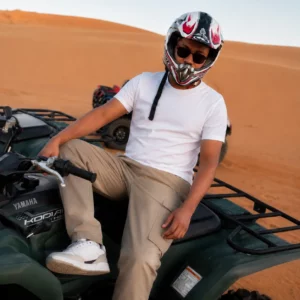
Desert trips are usually multi-day affairs that involve a long drive through the High Atlas, often via the Tizi n’Tichka pass or through the Todra and Dades gorges, before reaching the dunes near Merzouga or Zagora. A Sahara Desert private guide handles far more than commentary here: route planning, timing stops at gorges and kasbahs, coordinating the camel trek and overnight camp, and providing context on the Berber and nomadic communities along the way.
This is also where the distinction between a driver and a guide matters most. A driver gets you there safely. A guide explains what you’re passing, from the geology of the gorges to the history of the old caravan trade routes that once crossed this same desert.
Morocco Private Driver and Guide: What’s the Difference?
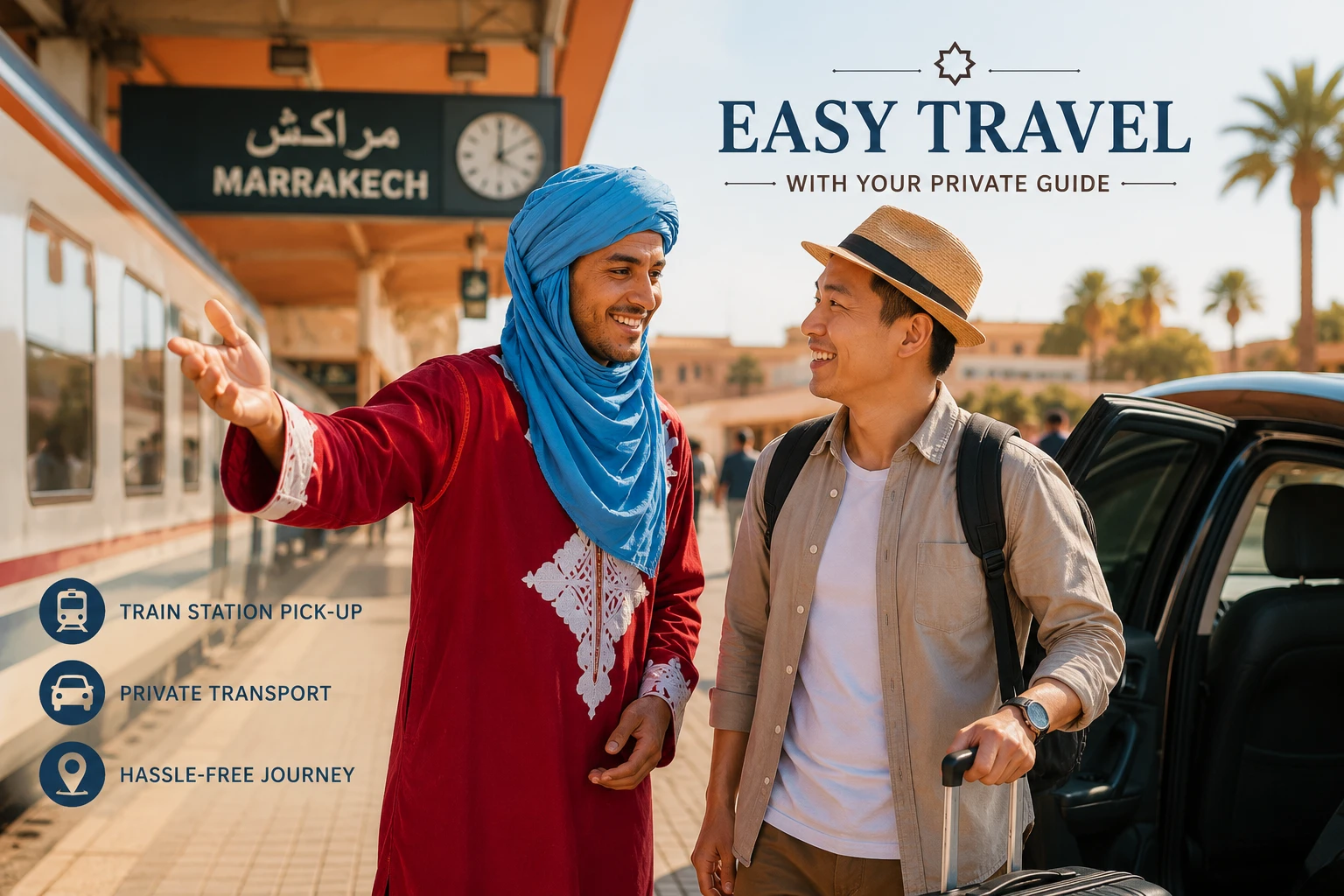
These two roles are often bundled together, but they are legally and practically distinct. A driver is licensed to transport passengers and knows the roads well, but is not authorized to give official historical or cultural commentary inside classified monuments and medinas. A licensed guide is trained and certified specifically for that interpretive role, and in many classified sites, only an accredited guide is permitted to lead groups through certain areas.
For trips that involve significant driving, such as a multi-day loop through the desert or the Atlas Mountains, many travelers book a combined driver-guide, or a driver and guide working together, so that the hours on the road are covered by someone comfortable with mountain driving while a licensed guide handles the cultural and historical side once you arrive at each stop.
How to Choose the Best Private Guide in Morocco
Not every guide is the right fit for every traveler, so a bit of screening before booking tends to pay off:
- Confirm the license. A certified tour guide in Morocco should be able to show or reference their official accreditation from the Ministry of Tourism without hesitation.
- Match the language. If you need a guide who is genuinely fluent, not just conversational, say so upfront, especially for anything beyond English, French, or Spanish.
- Ask about specialization. Some guides focus on history and architecture, others on food, photography, or desert logistics. Choose based on what actually interests you.
- Read recent reviews carefully. Look for comments about communication and flexibility, not just the sites visited.
- Talk before you book. A short exchange of messages usually reveals whether a guide listens to what you want or simply pushes a fixed, generic itinerary.
Building a Morocco Private Itinerary Around Your Guide
One underrated advantage of hiring a guide early in the planning process is that a Morocco private itinerary can be shaped around your actual interests rather than a template. A common structure starts in Marrakech for two or three days, continues over the Atlas to the Sahara for a two-day desert loop, and finishes in Fes before flying out, but this sequence bends easily. Travelers focused on architecture might add extra time in Fes and Meknes. Those drawn to coastal towns often extend the trip toward Essaouira for its Atlantic port and relaxed pace. Because the guide isn’t locked into a fixed group schedule, these changes can usually be made even after the trip has started.
Is It Worth Hiring a Private Guide in Morocco?
For most first-time visitors, the honest answer is yes, particularly in dense medinas like Fes and Marrakech, or for multi-day desert routes where logistics and driving distances add real complexity. The value is clearest for travelers with limited time who want to see as much as possible without wasting hours lost or negotiating unfamiliar transport, for families and solo travelers who want an extra layer of comfort, and for anyone genuinely interested in the history and culture behind what they’re looking at rather than just the view.
It matters less for travelers on a strict backpacker budget who are comfortable navigating with offline maps and don’t mind a slower, more improvised pace, or for repeat visitors who already know a city well. Even then, many return travelers still hire a guide for one specific piece of a trip, such as a desert crossing or a single deep dive into a medina’s artisan quarters, rather than for the entire journey.
| Traveler Type | Private Guide Worth It? | Why |
|---|---|---|
| First-time visitor, short trip | Yes | Maximizes limited time, avoids getting lost |
| Family with children | Yes | Extra comfort, safety, and flexible pacing |
| Solo traveler | Usually yes | Local support, easier navigation, added comfort |
| Backpacker on a tight budget | Optional | Group tours or self-guided routes may fit better |
| Repeat visitor | Situational | Often worth it for one specific leg, like the desert |
Frequently Asked Questions
It isn’t legally required for general travel, but it’s strongly recommended in dense medinas like Fes and Marrakech, where navigation without local knowledge is genuinely difficult. For remote regions such as the Sahara or the Atlas Mountains, a guide also adds real safety and logistical value.
It depends on your priorities. If you want deeper cultural context, easier navigation, and a schedule built around your interests, a guide is worth it. If you prefer a slower, self-directed pace and don’t mind occasionally getting lost, independent exploration works too, especially in smaller towns.
Costs vary by city, season, and trip length, and are usually charged per group rather than per person. Half-day and full-day city tours sit at the lower end, while multi-day trips with a driver-guide and desert excursions cost more due to transport and accommodation.
A driver handles transport and road logistics but isn’t certified to give official cultural or historical commentary inside classified sites. A licensed guide is trained specifically for that interpretive role. Many multi-day trips combine both.
Many are, along with French and Spanish, since Morocco receives a large number of visitors from all three language backgrounds. If fluency in a specific language is essential to you, confirm it directly with the guide before booking rather than assuming.
Neither is universally better. A private tour offers more flexibility, personal attention, and a pace set entirely by you, while a group tour is generally cheaper per person. The right choice depends on your budget and how much control you want over your schedule.
Conclusion
Morocco rewards curiosity, but its medinas, mountain roads, and desert distances also reward preparation. A private guide in Morocco won’t be the right fit for every traveler or every trip, but for anyone navigating Fes or Marrakech for the first time, planning a multi-day desert crossing, or simply wanting a deeper understanding of what they’re seeing, it tends to be one of the more worthwhile investments in the entire trip. The clearest way to decide is to weigh your own budget, pace, and curiosity against the comparisons above, and choose the format that actually matches the trip you want to have.